
This post may contain affiliate links. For educational purposes only, not medical advice. Details
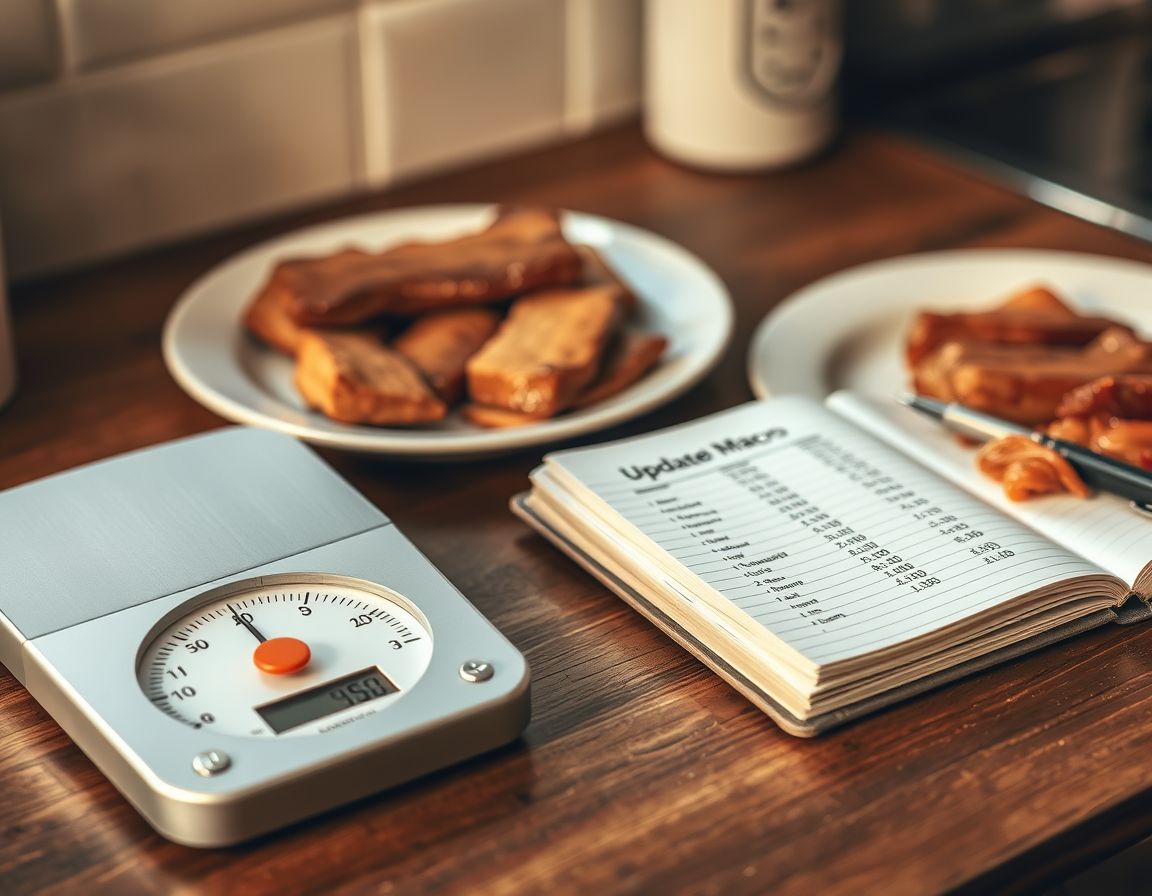
Lost 20 pounds? Good. Now your numbers are out of date. A smaller body burns fewer calories, so the target you set on day one slowly drifts toward maintenance. Same plate, smaller deficit, slower loss. That's not your metabolism breaking. It's arithmetic.
The fix is simple. Run your numbers again at your current weight every 10 to 20 pounds, or when you're genuinely stalled. If you want a quick way to do it, our free macro calculator asks for your goal weight and bases your protein on it, so you only have to update your current weight and let the calorie side move. Below is what changes, what stays put, and a worked example with every step shown.
Why the old number stops working
Your daily burn, your TDEE, is mostly the energy it takes to run and move your body. Less body, less energy.
So a target that was a solid deficit at your starting weight becomes a small one later. Nothing went wrong. You just used up some of the gap. If you want the background on why these estimates look low in the first place, start with why your carnivore TDEE number looks low.
When to recalculate
- Every 10 to 20 pounds lost. Under 10, the change is too small to matter.
- A genuine stall. Not a slow week. A real stall means 3-4 weeks with no movement on the scale or the tape measure.
One more rule. In your first 8 weeks, don't count at all. Eat to satiety. Recalculating is a tool for later, once the early water drop is behind you.
If you're stalled, recalculating is step four, not step one
Don't jump straight to cutting food. Run the stall order:
- 1. Confirm it's real. 3-4 weeks flat, checked with a tape measure, not just the scale.
- 2. Check sleep, stress and electrolytes.
- 3. Run a 7-day food audit. Write down everything, including added fat and dairy.
- 4. Recalculate at your current weight. This is where today's post lives.
- 5. Then try a 2-week dairy elimination or a planned maintenance break.
We walk through steps one to three in more detail in what to change when you stall at month three.
What changes and what doesn't
Protein stays anchored. It's set at 0.8-1.0 g per pound of your goal body weight. Your goal didn't move, so your protein doesn't either. Protein protects muscle while you lose.
Calories come down a little. Your new maintenance is lower, so your target follows it.
Added fat is where the change comes from. Protein is the anchor. Fat is the lever. Trim the butter, tallow and fatty extras first. Never cut the steak to make the math work.
Worked example: Linda, 58
Linda is 58 and 5'4". She started at 190 pounds. She's now at 170. Her goal is 145. She walks most days, so we'll call her lightly active.
We'll use one common estimate, the Mifflin-St Jeor equation, with a light activity multiplier of 1.375. It's a starting point, not a verdict.
Day one, at 190 pounds (86.2 kg):
- Resting burn: (10 x 86.2) + (6.25 x 162.6 cm) - (5 x 58) - 161 = about 1,427 calories
- Daily burn: 1,427 x 1.375 = about 1,960 calories
- Target with a 400-calorie deficit: 1,960 - 400 = 1,560 calories
This is not for everyone. Talk to your doctor first if you have high blood pressure, kidney or heart problems, diabetes, are pregnant, or take medicine.
A 400-calorie daily gap is 2,800 a week. At roughly 3,500 calories per pound, that's about 0.8 pounds a week. A good pace over 50.
Now, at 170 pounds (77.1 kg):
- Resting burn: (10 x 77.1) + 1,016 - 290 - 161 = about 1,336 calories
- Daily burn: 1,336 x 1.375 = about 1,840 calories
- Old target of 1,560 is now only a 280-calorie gap
280 x 7 = 1,960 a week. That's about 0.56 pounds a week. Still loss, but 30% slower than when she started. The math doesn't lie. She didn't change anything. Her body did.
Linda's new numbers
Protein, unchanged. 145-pound goal x 0.9 g = about 130 g a day. That's 520 calories (130 x 4). Same as day one.
New calorie target. 1,840 - 400 = 1,440 calories. That brings her back to about 0.8 pounds a week.
Fat fills the rest.
- Before: (1,560 - 520) / 9 = about 115 g fat
- After: (1,440 - 520) / 9 = about 102 g fat
- Difference: 13 g of fat, or about 120 calories
That's roughly one tablespoon of butter a day. One. Not smaller steaks. She drops the butter on her eggs and keeps everything else.
Her day might look like three meals of about 40 g protein each, plus two eggs as a snack. That's 132 g, right on target, and it keeps each meal in the 30-40 g range that works well after 50.
Her fat now sits a bit under her protein in grams, around 0.8 to 1. That's normal while cutting, since the 1:1 ratio is a satiety baseline, not a rule. If she's hungry all afternoon, that's the signal to add a little fat back. For more on that balance, see the fat to protein ratio that stalls fat loss.
Here's the protocol
- Step 1. Weigh yourself 3 mornings in a row and use the average.
- Step 2. Recalculate with your current weight. Keep the same goal weight.
- Step 3. Leave protein where it was.
- Step 4. Take the calorie difference out of added fat first.
- Step 5. Run it for 4 weeks before you judge it. Check the tape measure, not just the scale.
Common mistakes to skip
- Cutting protein to save calories. That costs muscle. Keep it anchored.
- Chasing a faster pace. A bigger deficit usually means more hunger and less muscle.
- Cutting when you don't need to. If you're still losing about half a pound to a pound a week, your plan is working. Recalculating tells you where you stand. It doesn't force a cut.
Keto readers, the same logic applies with carbs in the mix. KetoDial covers it in why to recalculate your keto macros every 10 pounds.
Stop overthinking it. New weight, same goal, same protein, a little less added fat. Run it for a month.
I'm not a doctor. I'm a guy who runs his food like a training block: set the numbers, test them, write down what happens, adjust. Everything here is based on what works in practice and what the research supports. Your mileage may vary.