
This post may contain affiliate links. For educational purposes only, not medical advice. Details
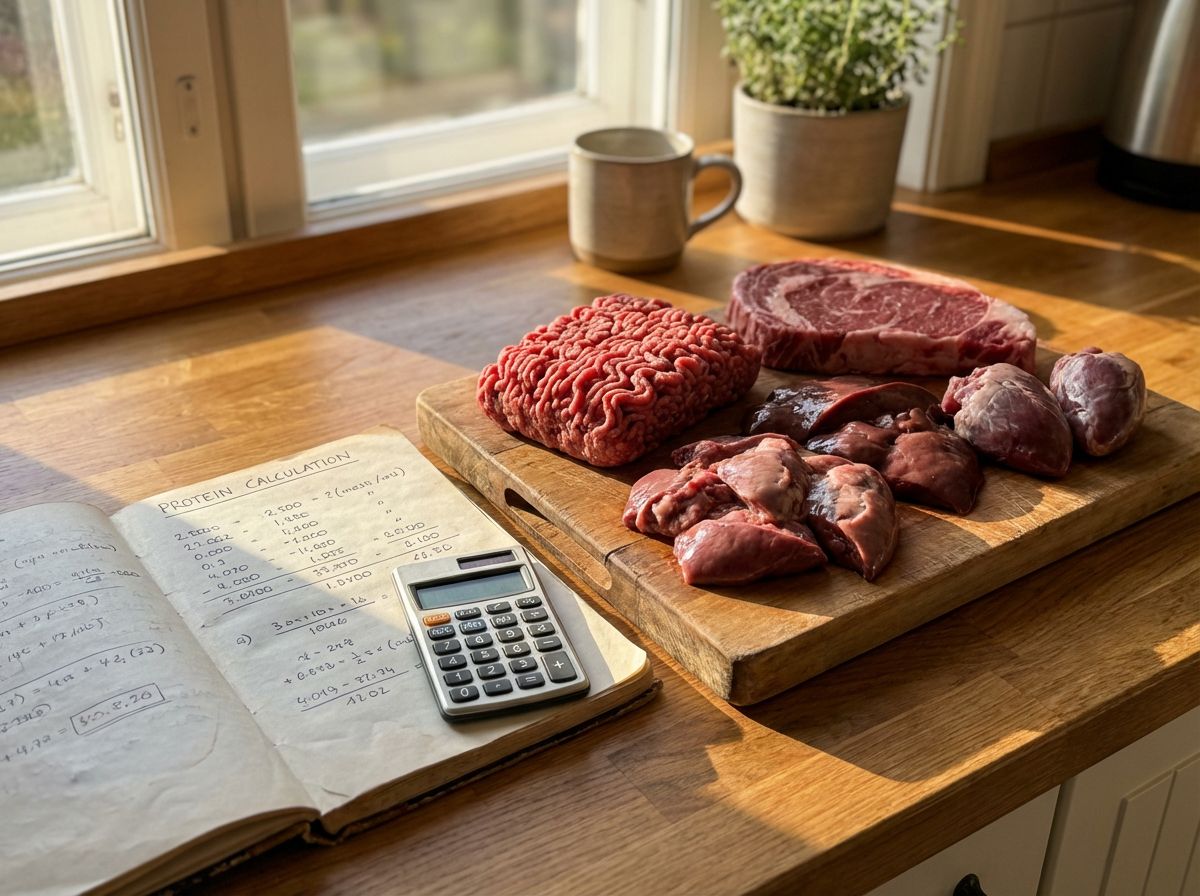
This is the question I see more than almost anything else in carnivore communities. "How much protein should I eat?" And the replies are all over the place. Someone says 0.8 grams per pound. The next person says 1 gram. Another person insists it's 1.5 or you're wasting your time. Meanwhile you're standing in front of the meat counter wondering if you need two pounds of ground beef today or three.
Here's the thing. They're all giving different numbers because they're answering different questions. Your protein target depends on what you're trying to do. Let's sort this out.
Why Does Everyone Give Different Protein Numbers?
The short answer: because context matters and nobody includes theirs.
When someone on Reddit says "I eat 1 gram per pound and I'm fine," they might be a 180-pound guy who lifts four days a week and is trying to maintain. That number works for him. It probably won't work for a 140-pound woman trying to lose body fat while keeping muscle.
The 0.8g/lb number comes from older RDA guidelines. It's the minimum to prevent deficiency, not the amount for optimal health. The 1g/lb number is a popular fitness rule of thumb. The 1.5g/lb number tends to come from fat-loss-focused practitioners and researchers who've found higher protein helps preserve lean mass during a deficit.
None of them are wrong. They just apply to different situations. So let's match the right number to your actual goal.
How Much Protein for Fat Loss?
If you're trying to lose fat and keep your muscle, protein becomes your most important lever.
Dr. Donald Layman, who spent decades studying protein metabolism at the University of Illinois, has made this point repeatedly: when you're in a caloric deficit, higher protein intake is what protects your lean mass from being broken down for energy. His point is the one that matters: when you cut, protein is the last thing to cut.
Our house number for fat loss is 1.0 to 1.2 grams per pound of your goal body weight. If you weigh 200 pounds and you're aiming for 170, that's 170 to 204 grams a day. We use goal weight rather than current weight or lean body mass for two reasons. It doesn't inflate the target for a body you're trying to change, and you can work it out without a body-fat percentage you had to guess at.
That sounds like a lot. But on carnivore, you're eating almost entirely meat. Two pounds of ground beef plus a few eggs and you're already at 200+ grams. Most carnivore dieters hit this range naturally without even trying, which is one of the reasons the diet works so well for body recomposition.
Dr. Layman also emphasizes the leucine threshold: you need about 2.5 to 3 grams of leucine per meal to trigger muscle protein synthesis. A 6-ounce portion of beef gives you roughly 3 grams of leucine. So if you're eating two to three meat-based meals a day, you're hitting that threshold every time.
How Much Protein for Muscle Building?
If your primary goal is putting on muscle, you don't actually need as much protein as the fat-loss crowd. Counterintuitive, right?
Dr. Gabrielle Lyon, who focuses on what she calls "muscle-centric medicine," recommends 1 gram per pound of ideal body weight for people trying to build muscle. The reasoning: when you're eating at maintenance or a slight surplus, your body isn't under the same stress to break down muscle for energy. You need enough protein to fuel mTOR activation and muscle protein synthesis, but the threshold is lower than during active fat loss.
The key insight from Dr. Lyon's work is that it's not just total protein that matters. It's protein distribution. Three meals with 40 to 50 grams of protein each will build more muscle than one meal with 150 grams. Your body can only use so much for muscle synthesis in one sitting. The rest gets used for other functions (not wasted, just not going directly to muscle repair).
For most carnivore dieters focused on building muscle, something like this works well:
- Meal 1: 8 oz ribeye + 3 eggs (about 65g protein)
- Meal 2: 1 lb ground beef patties (about 90g protein)
- Total: roughly 155g for a 150-lb person, or about 1g/lb
If you're training hard, eating enough total food, and sleeping well, you'll build muscle in this range without any issues.
How Much Protein Just to Maintain?
Some of you aren't trying to lose fat or pack on muscle. You're on carnivore because it fixed your digestion, cleared your skin, or stabilized your energy. You just want to keep doing what you're doing.
For maintenance, 0.8 to 1.0 grams per pound of goal body weight is enough. We use goal body weight as the denominator on this site. It's the same standard Dr. Lyon uses, and it matters most for people with a lot to lose, because multiplying by your current weight inflates the target for a body you're not trying to feed. This is the range where your body has plenty of amino acids for repair, immune function, and normal turnover without any particular surplus.
Dr. Shawn Baker often points out that most long-term carnivore dieters settle into an intuitive eating pattern that naturally lands in this range. If you're eating until you're full and not restricting, your body tends to find its own balance.
For a 170-pound person at maintenance, that's roughly 136 to 170 grams per day. About 1.5 to 2 pounds of meat, depending on what cuts you're eating.
What Does That Look Like in Actual Food?
Numbers are useless if you can't translate them into food on your plate. So here's a quick reference. These are cooked weights.
| Food | Portion | Protein (approx.) |
|---|---|---|
| Ground beef (80/20) | 1 lb cooked | 90g |
| Ribeye steak | 1 lb cooked | 80g |
| NY strip steak | 1 lb cooked | 92g |
| Chicken thighs (skin-on) | 1 lb cooked | 85g |
| Salmon fillet | 1 lb cooked | 88g |
| Eggs (large) | 6 eggs | 36g |
| Bacon | 8 slices | 28g |
| Pork chops | 1 lb cooked | 100g |
| Beef liver | 4 oz cooked | 26g |
| Lamb chops | 1 lb cooked | 84g |
So if your target is 160 grams of protein per day, that's roughly a pound and a half of ground beef. Or a pound of ribeye plus half a dozen eggs. Or a pound of ground beef plus a salmon fillet. The combinations are straightforward once you know the numbers.
A useful rule of thumb: 1 pound of red meat gives you roughly 80 to 100 grams of protein. From there you can eyeball most meals without needing an app.
Can You Eat Too Much Protein on Carnivore?
This one comes up constantly. "Won't excess protein just turn into sugar?" It's the gluconeogenesis fear, and it's one of the most persistent myths in low-carb communities.
Here's what actually happens. Gluconeogenesis is the process where your body converts non-carbohydrate sources (including amino acids from protein) into glucose. It's a real metabolic pathway. But it's demand-driven, not supply-driven. Your body makes glucose when it needs it, not simply because you ate an extra steak.
Eating 200 grams of protein instead of 150 grams doesn't mean your blood sugar spikes and you "kick yourself out of ketosis." Multiple studies have confirmed this. Your liver produces glucose at a relatively constant rate regardless of protein intake, because the process is regulated by hormones (primarily glucagon), not by substrate availability.
The one scenario where too much protein actually is a problem? Rabbit starvation. This happens when you eat extremely lean protein with almost zero fat. Think: nothing but skinless chicken breast or wild rabbit (which is very lean). Without enough fat, your body can't process the protein properly, and you end up with nausea, diarrhea, and eventually real health problems.
But if you're eating ribeyes, ground beef, and eggs? You're nowhere near that territory. The fat-to-protein ratio in typical carnivore foods keeps you well within safe ranges.
Bottom line: eat your protein. Don't fear it. The "too much protein" problem is almost entirely theoretical for anyone eating fatty meat.
How Do You Calculate Your Exact Number?
Here's the quick formula if you want to do it yourself:
- Write down your goal weight. Not your current weight, and not a number off a chart. The weight you're actually working toward. If you don't have one, use the weight you last felt good at.
- Multiply by your goal factor:
- Maintenance: 0.8 to 1.0g per lb of goal body weight
- Muscle building: 1.0 to 1.2g per lb of goal body weight
- Fat loss: 1.0 to 1.2g per lb of goal body weight
- Convert to food. Divide your target by 90 (approximate grams per pound of ground beef) and that's roughly how many pounds of meat you need per day.
Or you can skip the math entirely.
Stop Guessing. Get Your Number.
Our free carnivore calculator builds your personalized protein target based on your weight, body composition, activity level, and goals. Takes 60 seconds.
Get Your Personalized Protein TargetThe calculator factors in everything we covered here, including your goal, your activity level, and your body composition, and gives you a daily protein target plus a practical meal plan to hit it.
Putting It All Together
Protein confusion is one of the biggest friction points for people starting or optimizing carnivore. But the actual answer isn't complicated once you know your goal.
If you're losing fat: aim higher, around 1.2 to 1.6g per pound of lean mass. Protein is your insurance policy against muscle loss.
If you're building muscle: 1.0 to 1.4g per pound of body weight, spread across two to three meals for best results.
If you're maintaining: 0.8 to 1.0g per pound. Eat until you're full and trust your appetite.
Don't overthink this. Eat fatty meat until satisfied, make sure you're hitting a reasonable protein minimum based on your goal, and let carnivore do what it does. Your body is smarter than a spreadsheet.
If you want a concrete starting point, run your numbers through our calculator. It takes a minute and saves you weeks of guessing.
References:Not a doctor. I'm just someone who's deep in this community and reads everything, so take the health stuff with a grain of salt, pun fully intended. The one place these numbers genuinely don't transfer is reduced kidney function, liver disease, or pregnancy, where protein targets get set by a clinician and not by a calculator. If that's you, get your number from them.
- Layman DK et al. Dietary protein and exercise have additive effects on body composition during weight loss in adult women. J Nutr. 2005.
- Lyon G. Forever Strong: A New, Science-Based Strategy for Aging Well. Atria Books. 2023.
- Baker S. The Carnivore Diet. Victory Belt Publishing. 2019.
- Fromentin C et al. Dietary proteins contribute little to glucose production, even under optimal gluconeogenic conditions in healthy humans. Diabetes. 2013.
- Phillips SM, Van Loon LJ. Dietary protein for athletes: from requirements to optimum adaptation. J Sports Sci. 2011.