
This post may contain affiliate links. For educational purposes only, not medical advice. Details
Just Here for the Calculator?
It's free, takes about 90 seconds, and gives you protein, fat, calorie, and electrolyte targets for carnivore, keto, low-carb, or pescatarian (this article will still be here when you're done).
Get My NumbersEvery Macro Calculator Gets This Wrong (Unless It's Built for Your Diet)
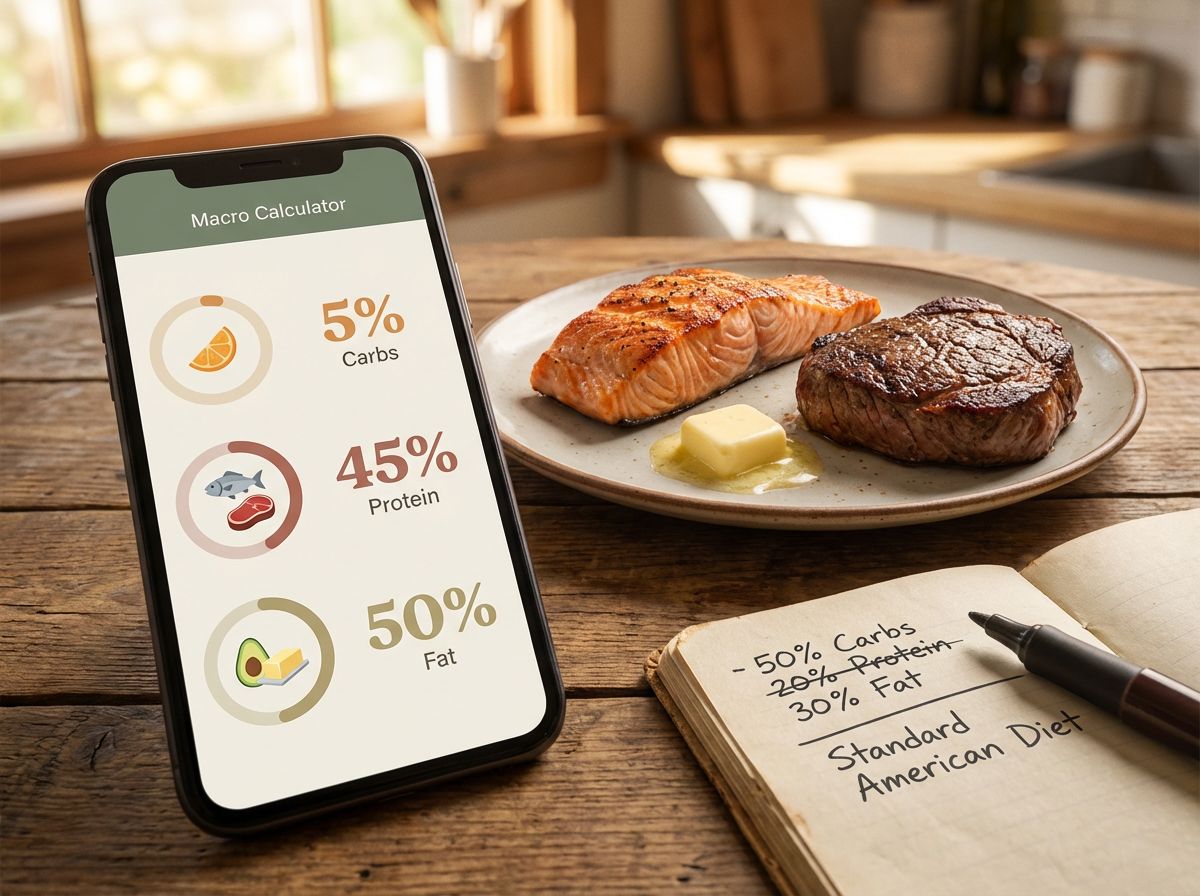
You open MyFitnessPal. You punch in your weight, your height, your activity level. It spits out a number. 2,200 calories. 45% carbs, 30% protein, 25% fat.
There's one problem. You don't eat carbs.
If you're carnivore, keto, or low-carb, every assumption baked into that calculator is wrong. The protein target is too low. The fat ratio doesn't account for ketosis. The electrolyte section doesn't exist. And the calorie estimate is based on a metabolic model that assumes you're burning glucose as your primary fuel.
You're not. So the numbers are fiction.
We built a free carnivore calculator that starts from your actual diet type and works outward. It's also a free keto calculator and a low-carb macro calculator, because it adjusts for each eating pattern individually. Free personalized macros in 90 seconds. And if you want the full picture, the $29 Complete Carnivore Protocol adds a 30-day meal plan, weekly grocery lists, a doctor's consultation script, and an adaptation timeline built around your body and goals.
Three of our writers tested it, picked it apart, and put it through the lens of their own expertise. Here's what they found.
The Science Problem with Standard Calculators
By Sarah, Health Coach
If you've been plugging your stats into a generic carnivore diet calculator or keto calorie calculator and wondering why the results feel off, there's a reason. Those calculators use the Mifflin-St Jeor or Harris-Benedict equations, and both were developed using populations eating mixed diets with significant carbohydrate intake. The energy partitioning models assume roughly 50% of your calories come from carbs. When your carb intake is near zero, the math breaks.
Here's what the textbook skips. On a high-fat, moderate-to-high-protein diet, your body processes energy differently. Fat oxidation becomes your primary metabolic pathway. Your liver produces ketone bodies for fuel. Gluconeogenesis handles the small amount of glucose your brain and red blood cells still need. None of this is reflected in a calculator that was calibrated on people eating sandwiches and pasta.
The Protein Leverage Problem
There's a concept in nutritional science called the protein leverage hypothesis. Researchers at the University of Sydney, led by Professors Simpson and Raubenheimer, published data in 2005 and expanded on it through 2020 showing that humans have a fixed protein appetite. Your body drives you to eat until you hit a protein target, regardless of how many calories you consume along the way.
On a standard diet with 12-15% protein, that means overeating total calories to satisfy the protein need. On carnivore with 30-40% protein, you hit your target faster and naturally stop eating sooner. Standard calculators don't model this. They treat protein as just another macronutrient. It's not. It's the regulatory signal for appetite, and getting the target wrong cascades into everything else.
A 2021 clinical review in Obesity Reviews (Gosby et al., 2014; updated by Hall et al., 2021) confirmed that protein leverage explains a significant portion of the obesity epidemic. People aren't overeating because they lack willpower. They're overeating because ultra-processed foods dilute protein, forcing higher total calorie consumption to meet the body's protein demand.
On carnivore, this problem disappears. But you still need to know your actual target. And a calculator built for mixed diets won't give you the right one.
Fat Adaptation Changes the Equation
After 3-6 weeks of sustained low-carb eating, your cells upregulate fat oxidation enzymes. Mitochondrial density increases in muscle tissue. Your body becomes measurably more efficient at burning fat for fuel. This is called fat adaptation, and it's well-documented in the exercise physiology literature (Volek et al., 2015, Journal of Physiology).
What this means for your macro calculations: your basal metabolic rate on a fat-adapted diet is not the same as your BMR on a carb-based diet. The thermic effect of food differs. The respiratory quotient shifts. A generic TDEE calculator can't account for any of this because it doesn't ask what you eat. It only asks how much you weigh and how active you are.
Our calculator asks your diet type first. Carnivore, keto, low-carb, or pescatarian. Then it adjusts protein requirements, fat ratios, and electrolyte targets based on the metabolic reality of that specific eating pattern. That's the difference between a number you can use and a number that sends you chasing the wrong targets for months.
Electrolytes: The Missing Section
Standard calculators don't mention electrolytes. At all. On carnivore and keto, electrolyte management is critical. When insulin drops, your kidneys excrete more sodium. Magnesium and potassium requirements shift. Without proper supplementation in the first 4-6 weeks, you get headaches, cramps, brain fog, and fatigue that people wrongly blame on the diet itself.
Our calculator includes electrolyte targets. Sodium, potassium, magnesium. Personalized to your body weight and activity level. Because knowing your protein and fat targets doesn't help if you feel terrible from electrolyte depletion. The full protocol goes further with a complete electrolyte supplementation schedule, specific brands I recommend, and week-by-week dosage adjustments as your body adapts.
One thing I tell every client: bring data to your doctor, not opinions. The protocol includes a doctor consultation guide with the exact lab tests to request (comprehensive metabolic panel, lipid panel, insulin, CRP, vitamin D, B12, ferritin) and a framework for discussing your diet with a physician who may not be familiar with carnivore or keto. That single section could save you an awkward appointment and ensure you're actually getting monitored properly.
I'm a health coach, not a physician. This calculator gives you a starting framework based on published research and clinical observation. It's not a substitute for working with your doctor, especially if you're managing a medical condition or taking medication.
Try the Free Calculator
See your personalized carnivore macros in 90 seconds. Completely free.
Calculate My Macros →Doing keto instead? We built a calculator for that too
KetoDial is our keto sister site. It runs the same math as the carnivore calculator, with carb targets built in rather than bolted on afterwards.
Try the keto calculator ›Your Generic Calculator Is Holding You Back
By Marcus, Performance Coach
I've coached over 200 athletes and serious lifters through carnivore and keto transitions in the last three years. At least half of them walked in with macro targets from MyFitnessPal, Cronometer, or some random website calculator. And almost every time, the numbers were wrong.
Not a little wrong. Fundamentally wrong.
The Three Mistakes I See Every Week
Mistake 1: Protein way too low. A 200-pound guy eating keto gets told to eat 120 grams of protein to "stay in ketosis." That's complete nonsense. Research from Dr. Jose Antonio's lab at Nova Southeastern University (2014, 2016) tested protein intakes up to 3.3g/kg in resistance-trained individuals. Nobody got kicked out of ketosis. Nobody gained fat from protein. The "excess protein turns to sugar" fear is based on a misunderstanding of gluconeogenesis, which is demand-driven, not supply-driven.
On carnivore or keto with a training goal, you need 0.8 to 1.0 grams per pound of goal body weight, and up to 1.2 if you train hard. Period. Generic calculators typically suggest 0.8g/lb of total body weight. For a 200-pound guy at 25% body fat, that's the difference between 160 grams (what the generic calculator says) and 225 grams (what he actually needs for optimal muscle protein synthesis).
Mistake 2: Fat percentages copied from standard keto templates. A blanket "75% fat" recommendation ignores context entirely. If you're trying to lose body fat on carnivore, you don't need to add fat to everything. Your body has plenty of stored fat to burn. I've seen guys stall for months because they were drowning ribeyes in butter and drinking bone broth with added tallow. They hit their calorie ceiling without ever accessing stored body fat.
Fat is the adjustment lever, not the foundation. Protein is your foundation. Set protein first. Then adjust fat up or down based on your goal: more fat for maintenance or muscle gain, less added fat for fat loss.
Mistake 3: Zero electrolyte guidance. A guy starts carnivore, trains hard, and within four days he's cramping, dizzy, and can barely finish a warm-up set. He blames the diet. The diet isn't the problem. The missing salt is the problem. Every serious low-carb athlete needs a sodium, potassium, and magnesium protocol from day one. No generic calculator even mentions this.
What This Calculator Gets Right
I ran my own numbers through it. I also ran numbers for three of my current clients: a 185-pound CrossFit competitor on carnivore, a 155-pound female powerlifter on keto, and a 220-pound recreational lifter doing low-carb.
Every result matched what I would have prescribed manually within 5-10%. That never happens with generic calculators. The protein targets were solid. The fat ratios accounted for activity level. And the electrolyte recommendations were actually specific enough to be useful.
The $29 protocol adds what I can't give every client for free: a 30-day meal plan calibrated to their macros with actual recipes and portion sizes. A weekly grocery list organized by store section so they're not standing in Costco doing mental math. And an adaptation timeline that tells them exactly what to expect in weeks 1-2 (the rough part), weeks 3-6 (when performance comes back), and months 2-3 (when PRs start happening). I've started sending the protocol link to new clients before our first session so they show up with a baseline instead of confusion.
Here's the protocol I give clients now:
- Run the free calculator at carnivoreweekly.com/calculator
- Write down three numbers: daily protein target, daily fat target, daily calorie floor
- Hit the protein target first. Every day. Non-negotiable.
- Adjust fat based on hunger and goals. Losing fat? Don't add extra. Maintaining? Eat fattier cuts.
- Follow the electrolyte targets for the first 30 days minimum
Stop guessing. Stop copying macro splits from Reddit threads posted by people with completely different bodies and goals. Use a free carnivore calculator that actually understands how to calculate macros on carnivore. Get numbers that match your diet, your activity level, and your actual physiology.
See What Your Numbers Should Be
Stop guessing. Get your actual protein, fat, and calorie targets for your diet type.
Get My Targets →I Tried Every Calculator on the Internet. Here's What Happened.
By Chloe, Community & Lifestyle Writer
Before I found this calculator, I went on what I can only describe as a macro calculator binge. I was three months into keto transitioning to carnivore, I'd hit a plateau, and I wanted someone (or something) to just tell me what to eat. So I tried them all.
MyFitnessPal
First stop, the big one. MyFitnessPal gave me 1,650 calories, 186g carbs, 55g fat, 82g protein. I stared at 186 grams of carbs and laughed. The app has no idea what carnivore is. You can manually override the macros, but then you're just typing in your own numbers, which defeats the whole purpose of using a calculator. The food database is great if you eat packaged food with barcodes. I eat ground beef and eggs. Not super helpful.
Cronometer
Cronometer was better. It let me set a custom macro split and tracked micronutrients, which was genuinely useful for seeing my vitamin and mineral intake. But the calorie estimate still came from a generic TDEE formula. It didn't ask my diet type. It didn't know I was fat-adapted. And the protein recommendation was still anchored to outdated RDA guidelines. I spent 20 minutes setting it up and got numbers I didn't trust.
Carbon Diet Coach
This one adjusts over time based on your weigh-ins, which is smart in theory. But the initial setup still assumes a mixed diet. The algorithm needs weeks of data before it starts giving accurate recommendations, and during those weeks you're following targets that were calibrated for someone eating carbs. For carnivore specifically, the first month of numbers felt off. My protein was too low and my fat was set at a percentage that didn't make sense for someone eating only animal foods.
Ruled.me Keto Calculator
This one actually gets keto. It asks about net carbs, it understands ketosis, and the protein recommendations are more reasonable. But it's keto-specific, not carnivore-specific. It still builds in a carb allowance (even if it's 20g net). And it doesn't address the differences between keto and carnivore when it comes to protein needs, which are real. Carnivore dieters typically need and tolerate higher protein than strict keto followers.
Quick update since this review: we built a keto-specific tool ourselves. KetoDial's keto macro calculator does the same math tuned for net carbs, and the macros are free.
What Made This One Different
When I ran my numbers through the Carnivore Weekly calculator, it asked me something none of the others did: what kind of low-carb diet are you eating?
That one question changes everything downstream. Carnivore gets different protein ratios than keto. Low-carb gets different guidance than either one. Pescatarian gets adjusted recommendations for omega-3 ratios and seafood-based protein sources.
The free results gave me a protein target that was 30 grams higher than what Cronometer suggested. It gave me an electrolyte breakdown that matched what I'd figured out through months of trial and error. And the calorie range actually felt sustainable rather than punishing.
But honestly? The free results were just the starting point. What I really wanted was a meal plan with actual foods I eat. Not a list of macros I need to translate into meals myself at 7 PM when I'm tired and hungry.
The Full Protocol Solved That
The $29 Complete Carnivore Protocol includes a 30-day meal plan. Not a generic "eat steak for dinner" template. A day-by-day plan with recipes, portion sizes, and a weekly shopping list. For someone like me who spent three months figuring out carnivore through Reddit threads and YouTube videos and trial and error, having it all in one document would have saved me weeks of confusion.
It also includes an adaptation timeline, which I wish I'd had when I started. I went through the first two weeks of carnivore thinking something was wrong with me. Turns out the fatigue, the weird digestion, the salt cravings were all completely normal transition symptoms. The protocol maps out what to expect week by week so you're not panicking on day four.
Tell your doctor what you're doing. I know that sounds like a throwaway line, but I mean it. The protocol includes a doctor consultation guide with the specific lab tests to request and actual talking points for the conversation. Not "tell your doctor you eat meat." Real talking points, like how to explain why your LDL might be elevated on carnivore and why that's not necessarily the emergency they think it is. That's something none of the free calculators or Reddit threads ever gave me, and it's probably the most important section in the whole document.
The weekly grocery lists were the other thing that surprised me. I'm used to meal plans that say "4oz salmon, 2 eggs, 8oz ground beef" and leave you to figure out the shopping. This one organizes everything by store section (meat counter, dairy, frozen) with quantities for the full week. I literally screenshot the list and walk through the store checking things off. For someone who used to wander around aimlessly buying random cuts and hoping it added up, this was a game changer.
Get the Full Protocol
Meal plan. Grocery lists. Doctor's script. Adaptation timeline. All personalized to your body.
Start Free, Upgrade for $29 →Carnivore TDEE Calculator: How We Work Out Your Calories
TDEE stands for total daily energy expenditure. It's the number of calories your body burns in a full day, counting everything: keeping your heart beating, digesting food, walking the dog, and whatever workouts you fit in. Before you can set a sensible calorie target, you need a decent estimate of this number.
Our calculator estimates it in two steps. First, it works out your basal metabolic rate, the calories you'd burn doing nothing at all, from your age, sex, height, and weight using a Mifflin-St Jeor style formula. Then it multiplies that by an activity factor based on how much you actually move. A desk job and a landscaping job are very different math.
From there, we adjust for your goal. Weight loss gets a calorie deficit, maintenance stays right at your TDEE, and muscle gain adds a modest surplus. On carnivore, there's one more step that generic calculators skip: with carbs near zero, we set your protein target first, then fill the remaining calories with fat. That's what keeps you full and steady instead of hungry and guessing.
If you want to see your own numbers, the free calculator takes about 90 seconds.
What's in the $29 Complete Carnivore Protocol
The free calculator gives you your core numbers: protein, fat, calories, and electrolytes. That's useful on its own. A lot of people stop there, and that's fine. But the full protocol goes deeper. Here's exactly what the $29 gets you:
Your Personalized Macro & Calorie Targets
Not ranges. Not "aim for 1,800-2,400 calories." Your specific daily targets for protein, fat, and total calories based on your body stats, activity level, diet type, and goals. Plus electrolyte targets (sodium, potassium, magnesium) personalized to your weight, with dosage adjustments for the adaptation phase vs. long-term maintenance.
30-Day Meal Plan with Recipes
Breakfast, lunch, and dinner for 30 days. Not "eat steak." Actual recipes with ingredients, portions, and cook times tailored to your selected diet type. Carnivore plans focus on beef, eggs, and organ meats. Keto plans include approved vegetables and dairy. Pescatarian plans center on fish and seafood. Every meal hits your macro targets so you're not doing math at the dinner table.
Weekly Grocery Lists
Four weekly shopping lists organized by store section: meat counter, dairy, frozen, pantry. Quantities calculated for the full week's meals. Print it or screenshot it. Walk in, check things off, walk out. No wandering, no guessing, no buying random cuts and hoping it adds up.
Doctor Consultation Guide
This is the section Chloe called "the most important part," and she's right. It includes the exact lab panels to request (comprehensive metabolic, lipid, fasting insulin, CRP, vitamin D, B12, ferritin, thyroid), what your results mean in context of a low-carb diet, and scripted talking points for discussing your dietary choices with a physician. If your doctor sees elevated LDL and tells you to stop eating meat, this guide gives you the framework to have an informed conversation instead of an argument.
Adaptation Timeline
Week-by-week breakdown of what to expect. Weeks 1-2: the transition symptoms (fatigue, cravings, digestive changes) and exactly how to manage them. Weeks 3-6: when fat adaptation kicks in, energy stabilizes, and performance starts returning. Months 2-3: optimization phase, where you fine-tune based on how your body has responded. No more panicking on day four because you feel terrible. It's mapped out.
AI-Customized Obstacle Protocol
Based on your calculator inputs, the protocol identifies your likely obstacles (budget constraints, family meals, travel, eating out, social pressure) and gives you specific strategies for each. A single mom on a tight budget gets different advice than a traveling consultant who eats in airports four days a week.
Supplement Recommendations & Progress Tracking
Specific supplement brands and dosages for your diet type. Plus a tracking framework covering weight, measurements, energy levels, sleep quality, and digestion markers so you can see what's actually changing over time instead of guessing.
All 13 sections are delivered instantly as a PDF after payment. No drip emails, no login required, no subscription to cancel. One payment, one document, and the copy you save is yours to keep. Start with the free calculator and upgrade if you want the full protocol.
Is This Worth $29?
Here's the honest comparison.
A registered dietitian consultation runs $150-300 per hour. Most don't have specific expertise in carnivore or keto. You'll spend the first 20 minutes explaining what you eat and why, and they'll likely suggest you add vegetables back. If you find a low-carb-friendly nutritionist, that's great. You'll still pay $150+ for a single session.
A generic macro tracking app is free or $10/month. But as Chloe laid out above, the numbers are wrong for specialty diets. You're paying for precision you're not getting. Over a year, that's $120 for consistently inaccurate targets.
Piecing it together yourself from Reddit and YouTube is free but costs time. Weeks of searching for protein guidelines, electrolyte protocols, meal ideas, and adaptation timelines from dozens of different sources with conflicting information. Some of it is solid. Some of it is someone's uninformed opinion presented as fact.
The Complete Carnivore Protocol is $29. Once. Personalized macros, 30-day meal plan, grocery lists, doctor's script, adaptation timeline, obstacle protocol, supplement guide. It takes your specific inputs and generates it all in about 90 seconds. If you don't find it useful, there's a 7-day money-back guarantee. No hoops, no questions.
We're not pretending this replaces a doctor or a coach who knows your full medical history. It doesn't. But for the price of two fast-food meals, you get a structured starting point that's built for the way you actually eat. And the free version costs nothing to try.
Frequently Asked Questions
Is the calculator free?
Yes. The basic calculator is completely free. You enter your stats, select your diet type, and get personalized macro targets, calorie ranges, and electrolyte recommendations. No paywall on the results. The $29 Complete Carnivore Protocol is an optional upgrade that includes a 30-day meal plan, shopping lists, doctor consultation guide, and 10 additional personalized sections.
Does it work for keto, not just carnivore?
Yes. The calculator supports four diet types: carnivore, keto, low-carb, and pescatarian. Each diet type gets adjusted protein targets, fat ratios, and electrolyte recommendations based on the specific metabolic profile of that eating pattern. Keto users get slightly different protein guidance than carnivore users because the presence of some plant-based foods changes the calculation. The protocol meal plans are also tailored to your selected diet type.
What's in the $29 protocol?
The Complete Carnivore Protocol includes 13 personalized sections: your macro and calorie targets, a 30-day meal plan with recipes, weekly shopping lists, an adaptation timeline, a doctor consultation guide with recommended lab tests, electrolyte supplementation protocol, an AI-customized obstacle plan for your specific challenges, supplement recommendations, a progress tracking framework, and more. It's delivered instantly as a PDF after payment.
Is there a money-back guarantee?
Yes. Full refund within 7 days, no questions asked. If the protocol doesn't help you, email us and you'll get your $29 back. We'd rather have happy readers than unhappy customers.
How long does it take?
The free calculator takes about 90 seconds. You answer questions about your body stats, activity level, diet type, and goals. Results are instant. If you purchase the full protocol, it's generated and delivered immediately after payment. No waiting, no email drip. You get the complete PDF right away.
Try It. The Free Version Might Be Enough.
We're not going to pretend everyone needs the full protocol. Some people just need their protein number and they're good. The free calculator gives you that. Run your numbers, write them on a sticky note, and go eat.
If you want the 30-day meal plan, the weekly grocery lists, the doctor's consultation script, the adaptation timeline, and the full 13-section personalized protocol, it's $29 one-time. Not a subscription. Not a recurring charge. Just a PDF you download and keep.
Either way, stop using a calculator that was built for people who eat bread. Whether you need a carnivore diet calculator, a keto macro calculator, or a low-carb macro calculator, this one was built for you. Your diet is different. Your numbers should be too.
Ready for the Full Protocol?
13-section personalized protocol. 30-day meal plan. Shopping lists. Doctor guide.
$29 one-time
100% money-back guarantee within 7 days.
Get My Protocol — $29 →A note from all three of us: Nothing in this article is medical advice. Sarah is a health coach, Marcus is a performance coach, and Chloe is a community writer. We share what we've learned, what the research shows, and what real people experience. But your health decisions should involve your doctor. If you're on medication, managing a chronic condition, or have specific medical concerns, talk to a qualified physician before changing your diet or supplementation.
Once you have your macros dialed in, the next question is what to do with them. Marcus wrote a practical guide on losing fat and building muscle at the same time on carnivore that picks up right where the calculator leaves off.