
This post may contain affiliate links. For educational purposes only, not medical advice. Details
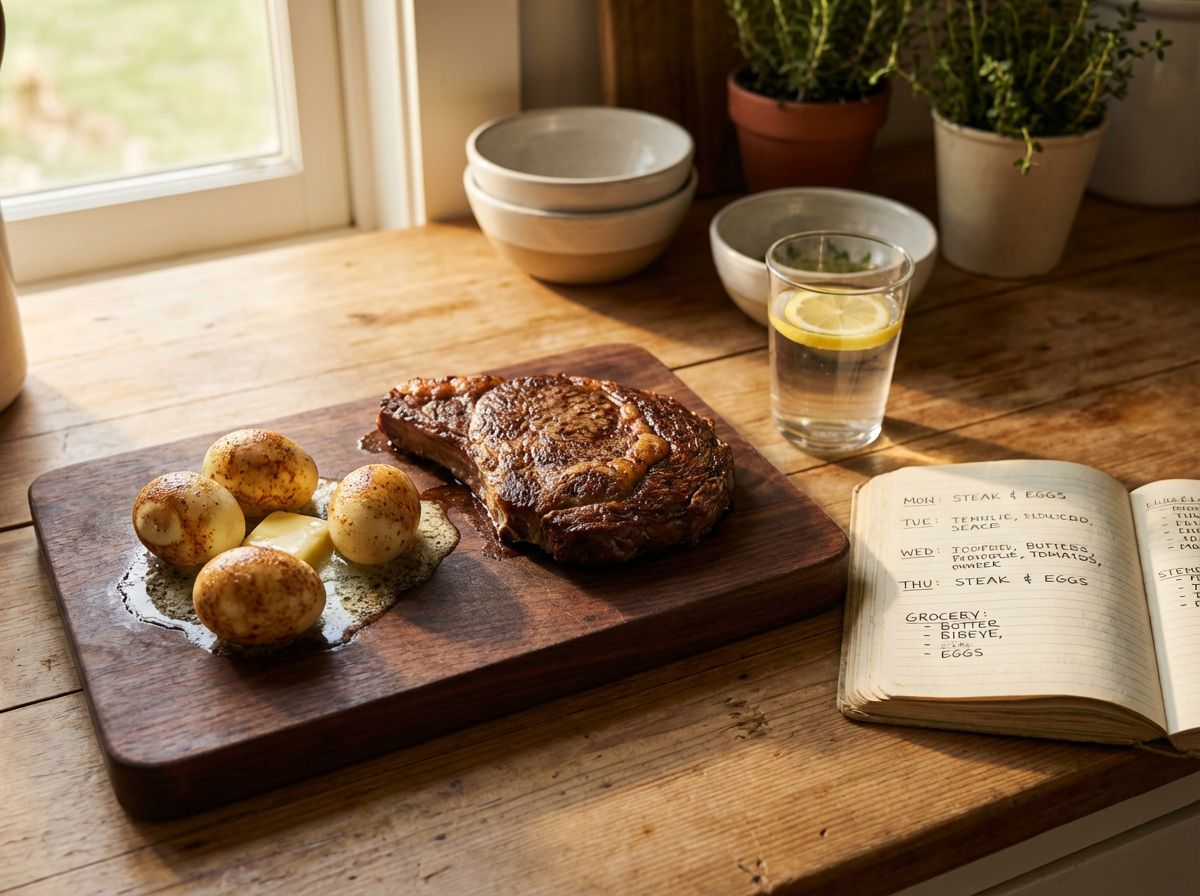
You've decided to go carnivore. Good. Now the question everyone gets stuck on: what do I actually eat every day?
It's simpler than you think. But "simple" doesn't mean "wing it." Having a plan, especially in the first few weeks, is the difference between sticking with it and falling off by Thursday because you're staring into an empty fridge at 7 PM.
This is the complete carnivore diet meal plan. No fluff. No $400-a-week grocery bills. Just a practical system you can start this weekend.
(Doing keto with some plants instead? KetoDial's 7-day beginner meal plan follows the same playbook with net carbs in the mix.)
What Does a Day of Eating Carnivore Actually Look Like?
Here's a realistic day for someone eating around 2,000-2,400 calories. This isn't a bodybuilder template or a weight-loss crash diet. It's what a normal adult eating carnivore looks like on a Tuesday.
Morning (8-9 AM):
- 4 eggs cooked in butter (320 cal, 24g protein, 24g fat)
- 3 strips thick-cut bacon (180 cal, 12g protein, 14g fat)
Afternoon (1-2 PM):
- Two 1/4 lb ground beef patties, 80/20 (560 cal, 40g protein, 44g fat)
- Salt to taste
Dinner (6-7 PM):
- 12 oz ribeye steak (900 cal, 66g protein, 70g fat)
- 2 tbsp butter on top (200 cal, 22g fat)
Daily totals: ~2,160 calories, ~142g protein, ~174g fat
That's it. Three meals. All animal foods. You're full, your protein is dialed, and your fat-to-protein ratio keeps energy steady all day. If you're larger or more active, add another patty at lunch or more eggs at breakfast. If you're smaller, cut the steak to 8 oz.
Not sure exactly how much you should be eating? Our free carnivore calculator gives you personalized macro targets based on your size, activity, and goals.
What Are the Best Foods for a Carnivore Meal Plan?
Not all animal foods are created equal. Here's how to think about it in tiers, ranked by nutrient density and how well they support your energy on this way of eating.
Tier 1: Ruminant Meats (Your Foundation)
- Beef: ribeye, chuck roast, ground beef (80/20 or 73/27), short ribs, NY strip
- Lamb: chops, leg, ground lamb, shanks
- Bison: ground bison, steaks
These should make up 60-80% of your food. Ruminant animals have the best fatty acid profiles and the highest concentration of bioavailable nutrients. Dr. Shawn Baker has been vocal about beef being the backbone of any carnivore plan, and the data backs him up.
Tier 2: Pork and Poultry (Supporting Roles)
- Pork: bacon, pork belly, chops, shoulder roasts
- Chicken: thighs (not breasts), wings, drumsticks
- Turkey: ground turkey (dark meat), thighs
Good for variety and budget. The key with poultry is to always pick dark meat. Chicken breast is too lean to sustain you on its own. You'll be hungry again in two hours.
Tier 3: Seafood (Nutrient Boosters)
- Salmon (wild-caught), sardines, mackerel
- Shrimp, scallops, oysters
- Cod, halibut (leaner, pair with butter)
Seafood is excellent for omega-3s and micronutrients like selenium and iodine. Dr. Paul Saladino often highlights the value of shellfish, especially oysters, for zinc and B12. You don't need seafood every day, but 2-3 servings per week adds nutritional depth.
Tier 4: Eggs and Dairy (If Tolerated)
- Eggs: whole eggs, any style
- Butter and ghee
- Hard cheeses: cheddar, parmesan, gouda
- Heavy cream (small amounts)
Eggs are one of the most nutrient-complete foods that exist. Dairy is more individual. Some people thrive with butter and hard cheese. Others get bloated, broken out, or congested. Test it. If dairy causes issues, cut it for 30 days and reassess.
How Do You Meal Prep on Carnivore?
Meal prep on carnivore is absurdly easy compared to any other diet. No measuring cups. No 17-ingredient recipes. Here's the Sunday batch-cook system that takes about 90 minutes.
The Sunday Cook (feeds one person for 5 days):
Batch 1: Ground Beef Base
- Brown 5 lbs of ground beef (80/20) in a large skillet or Dutch oven
- Season with salt only
- Divide into 5 containers (1 lb each)
- Total cost: ~$25-30
Batch 2: Slow Cooker Roast
- Drop a 3-4 lb chuck roast in the slow cooker with salt
- Cook on low for 8 hours
- Shred and divide into 4 portions
- Total cost: ~$15-20
Batch 3: Hard-Boiled Eggs
- Boil 18-24 eggs
- Peel and store in the fridge
- Grab 3-4 per day as snacks or meal add-ons
- Total cost: ~$6-8
Daily Assembly: Pull one container of ground beef, slice some chuck roast, grab a few eggs. Heat and eat. Dinner is the only meal you cook fresh, usually a steak or pork chops.
That's the whole system. No Tupperware towers. No recipe blogs. Cook meat in bulk, portion it, reheat it.
What Should Your Weekly Shopping List Include?
Here are three shopping lists at different price points. All feed one adult for seven days.
Budget Plan (~$65-80/week):
- Ground beef 80/20: 7 lbs ($28-35)
- Eggs: 3 dozen ($9-12)
- Butter: 1 lb ($4-5)
- Chuck roast: 3 lbs ($12-15)
- Bacon: 2 lbs ($8-12)
- Salt: already in your pantry
Mid-Range Plan (~$110-140/week):
- Ground beef 80/20: 5 lbs ($20-25)
- Ribeye steaks: 3 lbs ($30-40)
- Eggs: 2 dozen ($6-8)
- Butter: 1 lb ($4-5)
- Salmon fillets: 2 lbs ($16-22)
- Bacon: 2 lbs ($8-12)
- Pork chops: 2 lbs ($8-10)
- Cheddar cheese: 1 lb ($5-7)
Performance Plan (~$150-180/week):
- Ribeye steaks: 4 lbs ($40-55)
- Ground beef or bison: 5 lbs ($25-35)
- Wild-caught salmon: 2 lbs ($18-24)
- Eggs: 3 dozen ($9-12)
- Beef liver: 1 lb ($4-6)
- Lamb chops: 2 lbs ($16-20)
- Butter and ghee: 2 lbs ($8-10)
- Sardines: 4 cans ($6-8)
- Bone broth: 2 cartons ($8-10)
Money-saving tips that actually work:
- Buy ground beef in 10 lb tubes from Costco or a local butcher. Saves 20-30% per pound.
- Get a chest freezer. Buy full or half cows from local ranchers at $5-7/lb for the entire animal.
- Eggs are the cheapest high-quality protein per gram. Use them freely.
- Chuck roast is criminally underrated. Slow-cook it and it tastes like prime rib for a third of the price.
How Do You Calculate Your Macros for Carnivore?
Carnivore isn't about counting every gram. But knowing your ballpark numbers helps, especially if you have specific goals like fat loss, muscle gain, or athletic performance.
General guidelines:
- Protein: 0.8 to 1.0 grams per pound of your goal body weight, and up to 1.2 if you train hard. A 180 lb person aiming for 170 lbs should target 136-204g protein daily.
- Fat: Enough to feel satisfied. Most people land at a 1:1 to 2:1 fat-to-protein ratio by calories (not grams). If you're hungry between meals, you're not eating enough fat.
- Carbs: Zero or near-zero if you're strict carnivore. Trace amounts from eggs and dairy don't count.
How to tell if your macros are right:
- Steady energy from morning to night = you're dialed
- Crashing at 3 PM = probably not enough fat at lunch
- Always hungry = eating too lean, add fattier cuts
- Gaining unwanted weight = cut back on added fats (butter, tallow) slightly
If you want exact numbers customized to your body, use our carnivore macro calculator. It takes your stats, activity level, and goals, then builds a personalized target. It takes about 60 seconds.
What Are Common Meal Plan Mistakes?
After working with hundreds of people starting carnivore, these are the mistakes I see destroy meal plans every single time.
Mistake 1: Not eating enough fat
This is the number one killer. People come from the "lean protein" world and fill their plates with chicken breast and 93/7 ground beef. Then they're starving by 2 PM, white-knuckling through cravings, and blaming the diet. Fat is your primary fuel on carnivore. You need it. Cook with butter. Choose 80/20 ground beef. Pick ribeye over sirloin. Your energy and satiety depend on it.
Mistake 2: Undereating overall
Some people treat carnivore like a calorie-restriction diet from day one. Don't. During the first 4-6 weeks, eat whenever you're hungry. Your appetite will self-regulate once you're fat-adapted. Trying to force calorie restriction during adaptation makes the transition miserable and often leads to quitting.
Mistake 3: Overcomplicating it
You don't need carnivore recipe books. You don't need to make "carnivore pancakes" with egg whites and cream cheese. Steak. Ground beef. Eggs. Bacon. Salt. That's the meal plan. The people who succeed long-term are the ones who keep it dead simple. The ones who fail are usually the ones trying to recreate their old diet with animal-only ingredients.
Mistake 4: No meal prep system
Monday motivation is great. Wednesday at 6 PM with nothing defrosted, you're ordering pizza. The Sunday batch-cook system above takes 90 minutes and eliminates this problem entirely. Prep or fail. Those are your options.
Mistake 5: Skipping electrolytes in the first month
Your body dumps sodium when you cut carbs. If you don't replace it, you'll get headaches, fatigue, muscle cramps, and brain fog. Then you'll blame the diet instead of the easily fixable electrolyte gap.
Do You Need Supplements on a Carnivore Diet?
Meat is the most nutrient-dense food on the planet. A well-constructed carnivore meal plan covers almost everything. But there are a few gaps worth addressing, especially in the first 90 days.
Electrolytes, and the question to settle before you touch them:
If you take a daily pill for your blood pressure or your heart, a water pill, or anything to do with your kidneys, ask your doctor or your pharmacist before you increase sodium or potassium. That includes salt substitutes like Lite Salt or No Salt and it includes electrolyte packets, because some of those medicines already hold potassium in your body and extra on top is the problem rather than the help. Have the same conversation if a blood test has ever come back with a note about your sodium, your potassium or your kidney function. If you're not sure whether that's you, that's a reason to ask rather than to assume it isn't.
For everyone else, here's how I'd handle the first couple of months without printing numbers at you:
- Sodium: salt your food to taste, and expect your taste for it to climb in the first two weeks. Salted broth is a genuinely nice afternoon habit and it's food rather than a dose.
- Magnesium: the one where a supplement is often reasonable, and also the one where the right amount depends on what else you take. Ask your pharmacist, who can see your actual list, and buy the smallest bottle first.
- Potassium: this comes off the plate. A pound and a half to two pounds of varied animal food a day, with liver about once a week, covers it for most people. I'm not going to tell you to add a potassium supplement because your calves cramped, because cramping does not tell you which direction your potassium has moved, and getting that backwards is the version that matters.
If you want targets set against your own weight, activity and medication list rather than a range aimed at everyone, that's what a conversation with your own clinician is for.
Optional, depending on your plan:
- Vitamin D: If you're not getting regular sun exposure, 4,000-5,000 IU daily is a reasonable baseline. Get your levels tested to know where you stand.
- Omega-3 (fish oil): Only if you're not eating fatty fish 2-3 times per week. If salmon and sardines are in your rotation, skip this.
- Organ meats vs. supplements: If you eat liver once a week, you don't need a multivitamin. If the thought of liver makes you gag, desiccated liver capsules are a practical alternative.
What you don't need:
- Fiber supplements (your gut adapts, give it 2-4 weeks)
- Vitamin C supplements (fresh meat provides enough to prevent deficiency)
- Protein powder (eat real food)
- Pre-workout (black coffee and a steak works better)
Your 7-Day Carnivore Meal Plan (With Real Portions)
Here's a full week with actual portions, not just food names. This is built around the mid-range shopping list above, and it lands near 1,800 calories a day. Don't worry if that's not your number. The next section shows you how to scale every meal up or down.
Day 1 (Monday):
- Breakfast: 3 eggs cooked in butter, 2 strips of bacon
- Lunch: 6 oz ground beef patty with a slice of cheddar
- Dinner: 8 oz ribeye with a pat of butter
Day 2 (Tuesday):
- Breakfast: 3 eggs scrambled with 2 oz of leftover ribeye
- Lunch: 6 oz shredded chuck roast from your Sunday cook
- Dinner: 8 oz of pork chops (one large or two small)
Day 3 (Wednesday):
- Breakfast: 2 hard-boiled eggs, 3 strips of bacon
- Lunch: 6 oz ground beef, salted well
- Dinner: 6 oz salmon fillet with a tablespoon of butter
Day 4 (Thursday):
- Breakfast: 3 eggs fried in bacon grease
- Lunch: 6 oz chuck roast, reheated
- Dinner: 8 oz NY strip steak
Day 5 (Friday):
- Breakfast: 2 eggs, 3 strips of bacon
- Lunch: 6 oz ground beef with a slice of cheese
- Dinner: 8 oz of lamb chops or pork chops
Day 6 (Saturday): This is a natural two-meal day.
- Late brunch: 3 eggs, 3 strips of bacon, 4 oz ground beef patty
- Dinner: 10 oz steak, whatever cut is on sale
Day 7 (Sunday):
- Breakfast: 2 eggs with leftover steak slices
- Lunch: 1 can of sardines and 2 hard-boiled eggs
- Dinner: slow cooker chuck roast (this becomes next week's lunches)
A quick note on meal timing. Lots of people, especially women over 50, find they naturally drift to two meals a day once they're a few weeks in. That's fine. Just combine breakfast and lunch into one bigger meal. Don't force three meals if you're genuinely not hungry.
Scaling the Plan: 1,200, 1,500, and 2,000 Calorie Versions
The 7-day plan above works at any calorie level. You keep the same foods and the same structure. Only the portions change. Here's how each meal looks at three common targets.
1,200 calories (often fits smaller or less active women, typically 60+):
- Breakfast: 2 eggs, 2 strips of bacon
- Lunch: 4 oz (about 110 g) ground beef or roast
- Dinner: 5 oz (about 140 g) steak, pork, or salmon with a teaspoon of butter
1,500 calories (a common landing spot for women 45-65 focused on weight loss):
- Breakfast: 3 eggs, 2 strips of bacon
- Lunch: 5 oz (about 140 g) ground beef or roast
- Dinner: 7 oz (about 200 g) steak, pork, or salmon with a pat of butter
2,000 calories (larger folks, men, and anyone more active):
- Breakfast: 3-4 eggs, 3 strips of bacon
- Lunch: 7-8 oz (about 200-225 g) ground beef or roast
- Dinner: 10 oz (about 285 g) steak with a tablespoon of butter
One gentle warning: don't start at 1,200 just because it's the smallest number. In your first month, eat to comfortable fullness and let your appetite settle before you tighten portions. Cutting hard while your body is still adapting usually backfires.
These are starting points, not prescriptions. Everyone's baseline is different, and what works for most may not work for you, especially if you have underlying health conditions. If you want a target matched to your age, size, and activity, our free macro calculator builds one in about a minute.
The 80/20 Carnivore Plan and Your First 30 Days
You'll see "80/20 carnivore" used two ways in the community, and both are legitimate. The first meaning: about 80% of your food comes from ruminant meat (beef, lamb, bison), and the other 20% is flexible animal foods like eggs, dairy, chicken, pork, and seafood. That's exactly how the plan above is built, so if that's what you're after, you're already doing it.
The second meaning: 80% strict carnivore, 20% wiggle room. Someone eats meat, eggs, and butter most of the time but doesn't panic over coffee, seasonings, or the occasional low-carb vegetable at a family dinner. For a lot of people over 45, this version is what makes carnivore livable long term.
Pick whichever version you can actually sustain. Neither one is cheating. (And no, this has nothing to do with 80/20 ground beef. That's just the fat ratio on the label.)
Weeks 1-2: Adaptation
If you're taking medications, especially for blood pressure, blood sugar, your heart or your kidneys, loop in your doctor before you start rather than after. Those numbers can shift quickly on this way of eating, and medication doses sometimes need adjusting. Sodium and fluid belong in that same conversation. That's a discussion for someone who knows your full medical picture, not a blog post.
With that settled: expect some tiredness, headaches, or crankiness in the first fortnight as your body switches fuel sources. Often that's seasoning and food volume rather than anything wrong, so salt to taste and eat enough. Eat whenever you're hungry and don't count anything yet. Your only job is showing up to the next meal. If it's getting worse rather than better, or it arrives with a racing heartbeat or dizziness on standing, that's a phone call rather than more salt.
Weeks 3-4: Adjustment
Around week three, most people notice their appetite settling and their energy steadying out. Now you can start paying attention to portions. If you're never hungry at breakfast, drop to two meals. If dairy is leaving you bloated or stalled, cut it for the rest of the month and see how you feel.
Day 30 and Beyond
At the 30-day mark, take stock. Recalculate your portions if you've lost more than 10-15 pounds, since a smaller body needs less food. From there, rerun your numbers every couple of months or whenever weight loss stalls for three weeks or more. The plan stays the same. Only the portions keep pace with the new you.
The Bottom Line
A carnivore diet meal plan doesn't need to be complicated. Pick fatty cuts of ruminant meat as your base. Add eggs and bacon for variety. Cook in bulk on Sundays. Salt everything. Eat when you're hungry.
The people who succeed on carnivore aren't the ones with the fanciest meal plans. They're the ones who keep it simple, stay consistent, and don't quit when week two gets uncomfortable.
Start with the budget shopping list. Do the Sunday batch cook. Follow the sample day. Adjust from there based on how your body responds.
That's all there is to it. Now go buy some ground beef.
Related reading:
- Beginner's Complete Blueprint: How to Actually Start Carnivore
- The Seven Dollar Carnivore Survival Guide
- The Deep Freezer Strategy for Carnivore on a Budget
References:
- O'Hearn A. Can a carnivore diet provide all essential nutrients? Curr Opin Endocrinol Diabetes Obes. 2020.
- Lennerz BS et al. Behavioral Characteristics and Self-Reported Health Status among 2029 Adults Consuming a "Carnivore Diet." Curr Dev Nutr. 2021.
- Volek JS, Phinney SD. The Art and Science of Low Carbohydrate Living. Beyond Obesity LLC. 2011.