
This post may contain affiliate links. For educational purposes only, not medical advice. Details
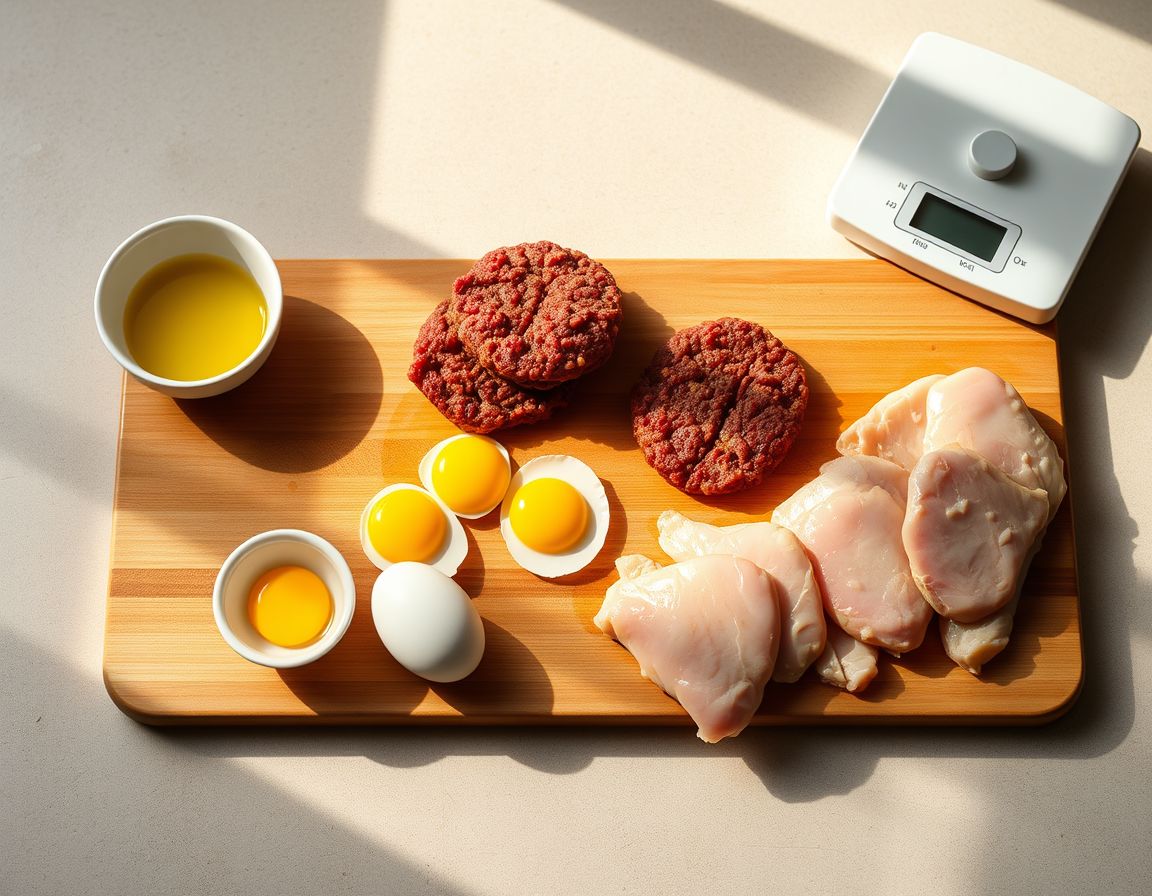
Here's what 2,000 calories of carnivore looks like on a plate: 12 ounces of cooked ground beef, 4 eggs, 6 ounces of chicken thighs and 4 tablespoons of butter, split across three meals. That lands at about 1,970 calories, 150 grams of protein and 148 grams of fat. Groceries run about $9-10 a day.
This is a sample, not a rule. It's built for readers starting at a higher weight or with a taller frame. Below: ounces per meal, the math, a grocery list, and how to tell if 2,000 is your number.
First, you probably shouldn't be counting yet
For your first 8 weeks, don't count calories. Eat meat until you're satisfied, protein first, and let your appetite settle.
So who is this page for? Two people. The reader who wants a clear picture of a full day of food before she starts. And the reader past week 8 who's stalled and wants to check her plate against something concrete. If you want a starting point for your own numbers, the free carnivore macro calculator works from your goal weight, not your current one.
Who this day was built for
She's 56, 5'9", starting at 230 pounds, with a goal of 165. This day fits her 5'11", 245-pound husband too.
Protein is set from goal weight. 0.8-1.0 grams per pound of a 165-pound goal is 132-165 grams a day. This plan lands at 150, right in the middle. Fat sits at about 1:1 with protein by grams, which is the baseline that keeps most people full. Protein is the anchor. Fat is the lever.
The numbers per item
All weights are cooked. Rounded standard figures:
- 80/20 ground beef, browned and drained: about 75 calories, 7 g protein, 5 g fat per ounce
- Chicken thigh, roasted with skin: about 65 calories, 7 g protein, 4 g fat per ounce
- Large egg: about 70 calories, 6 g protein, 5 g fat
- Butter: about 100 calories and 11 g fat per tablespoon
One pound of raw 80/20 cooks down to about 12 ounces once drained. That's this day's full beef ration, so you can brown one pound each morning and split it.
Salt your food well. When insulin drops on carnivore, your kidneys let go of more sodium and water, so most people need more salt than they're used to. Most people on carnivore land around 3-5 g of sodium a day, about 1.5-2 teaspoons of salt, spread through the day. One teaspoon of salt is about 2.3 g of sodium. This is not for everyone. Talk to your doctor first if you have high blood pressure, kidney or heart problems, diabetes, are pregnant, or take medicine.
The sample day (print this part)
Breakfast
- 4 large eggs: 280 calories, 24 g protein, 20 g fat
- 4 oz ground beef: 300 calories, 28 g protein, 20 g fat
- 1 tbsp butter for the pan: 100 calories, 0 g protein, 11 g fat
- Meal total: 680 calories, 52 g protein, 51 g fat
Lunch
- 6 oz chicken thighs, about 2 large bone-in thighs: 390 calories, 42 g protein, 24 g fat
- 1 tbsp butter: 100 calories, 0 g protein, 11 g fat
- Meal total: 490 calories, 42 g protein, 35 g fat
Dinner
- 8 oz ground beef: 600 calories, 56 g protein, 40 g fat
- 2 tbsp butter: 200 calories, 0 g protein, 22 g fat
- Meal total: 800 calories, 56 g protein, 62 g fat
Day total: about 1,970 calories, 150 g protein, 148 g fat. The math doesn't lie: 680 + 490 + 800 = 1,970. 52 + 42 + 56 = 150. 51 + 35 + 62 = 148. Drinks are water, black coffee or tea.
Every meal clears 40 grams of protein. After 50, spreading protein into solid 30-40 gram doses or more beats one giant plate at night.
Too much food, or not enough
- Can't finish it? Eat the meat first and leave the butter. Dropping 2 tablespoons cuts 200 calories and loses zero protein.
- Still hungry? Add 2 eggs (140 calories, 12 g protein) before you add more butter.
If you're shorter, lighter or closer to your goal, the 1,500-calorie version of this day is the better picture.
One-week grocery list
- 7 lb 80/20 ground beef (about $42 at $6 a pound)
- 2.5 dozen large eggs, 30 total (about $10)
- 5 lb bone-in, skin-on chicken thighs (about $10)
- 1 lb butter, 4 sticks (about $5)
- Salt
That's about $67 a week, or roughly $9.50 a day. It sits in the top half of the usual $5-10 a day for one person, and couples land around $7-10 each. Prices vary by region, and Whistler in ski season is not cheap. Beef is about two-thirds of the bill, so a family pack or a sale on ground beef moves your cost more than anything else. Wondering why 80/20 and not lean? Here's the 80/20 versus 93/7 breakdown.
How to tell if 2,000 is your number
Ignore the first week. A 3-7 pound drop then is mostly water. After that, judge by the trend over 3-4 weeks, with a tape measure as well as the scale.
- It's right if you're losing about 0.5-1 pound a week (a good pace over 50, and heavier starters can see up to 1.5), your waist is shrinking, and you're hungry at meals but not between them.
- It's too low if you're losing faster than 1.5 pounds a week past the first month and you feel cold, worn out, or think about food all day.
- It's too high, or something else is off, if nothing has moved on the scale or the tape for 3-4 weeks.
For a real stall, here's the protocol, in order. First, check sleep, stress and salt. Next, do a 7-day food audit that counts every pat of butter and bite of cheese. Then recalculate at your current weight. Last, try 2 weeks without dairy or a planned maintenance break. If you do trim, cut added fat first, never the meat. In this day, that's the 4 tablespoons of butter, worth 400 calories. More on that in what to do when you've stalled at month three.
One thing that won't change as you lose: your protein. It's tied to your goal weight, so 150 grams stays 150 grams. Fat and calories are what come down as you lose.
I'm not a doctor. I'm a former competitive athlete who treats food like a training plan: set the numbers, run them, write down what happened, adjust. This is what the math says and what works in practice. Your numbers may differ.