This post may contain affiliate links. For educational purposes only, not medical advice. Details
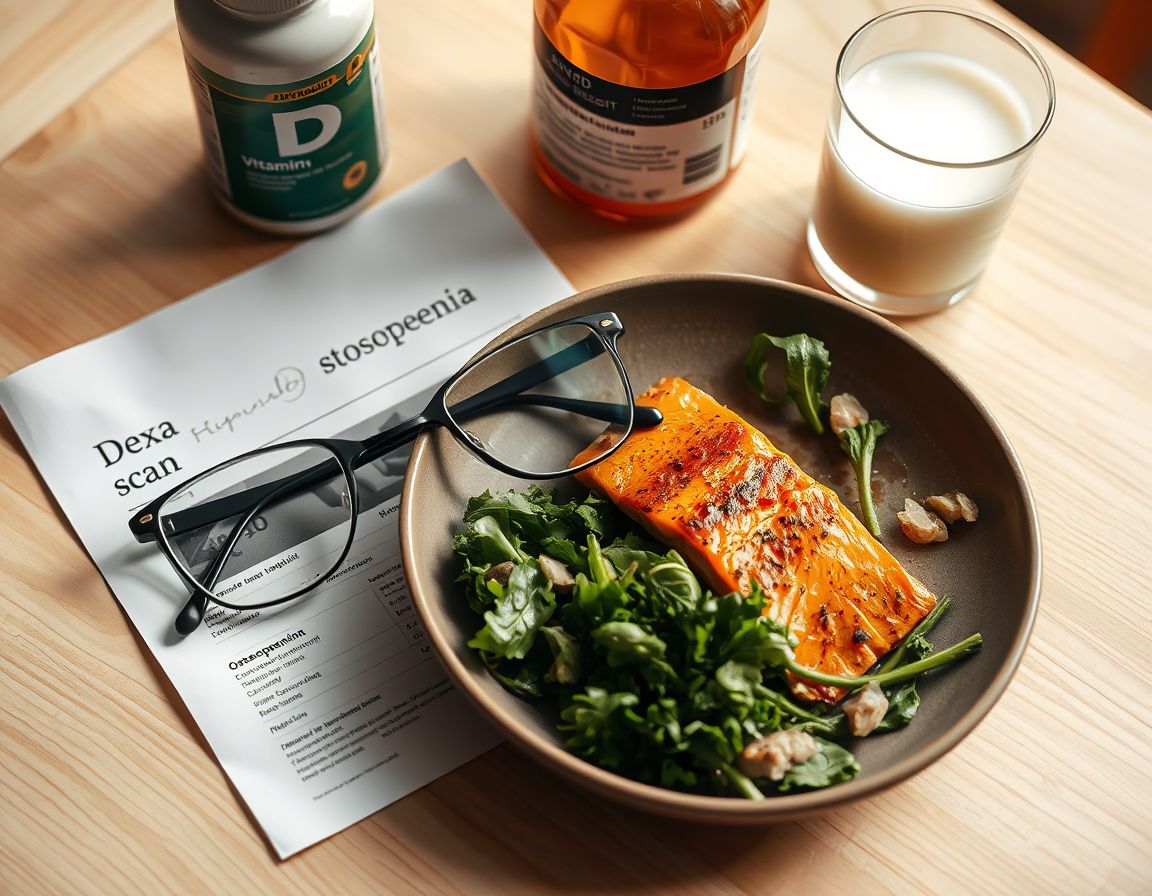
You've got the bone density report in your hand, the word "osteopenia" is circled, and you've just started carnivore to lose weight. Is it safe? For most women, carnivore can sit alongside an osteopenia result, as long as you protect three things on purpose: protein, calcium and vitamin D. Meat handles the first one well. The other two take some planning.
I wrote a broader piece on muscle, bone density and aging on meat earlier this year. This one starts from the scan itself. If you want a starting point for your own numbers while you read, the free macro calculator works from your goal weight.
What your T-score is telling you
A bone density scan (usually a DEXA) compares your bones to those of a healthy young adult. The gap is your T-score. Zero means you match that young adult. A minus number means your bones are less dense.
- Minus 1 and above: normal range.
- Roughly minus 1 to minus 2.5: osteopenia, lower than the reference but not osteoporosis.
- Below minus 2.5: osteoporosis.
Your report usually shows more than one site, often the hip and the lower spine, and they can differ. The T-score also isn't the whole picture. Your doctor may use a fracture risk tool like FRAX, which adds age, past fractures and family history. What your score means for you is a conversation with the person who ordered the scan.
Protein and bone: what the research shows
For years, people worried that a high-protein diet made your blood more acidic and pulled calcium out of your bones. It's called the acid-ash idea, and it sounded logical. It just hasn't held up well. Larger reviews, including meta-analyses of bone density and fractures, haven't found that higher protein harms bone in people who get enough calcium.
If anything, the research leans the other way. In older adults, higher protein intake is generally linked with slightly better bone density. Bone is about half protein by volume. Muscle protects bone too, by pulling on it and by keeping you steady on your feet.
Most people on carnivore land around 0.8 to 1.0 g of protein per pound of goal body weight, spread as 30 to 40 g per meal rather than one huge plate. That spread matters more after 50, because older muscle responds better to steady doses. This is not for everyone. Talk to your doctor first if you have high blood pressure, kidney or heart problems, diabetes, are pregnant, or take medicine.
Why weight loss changes the picture
Losing weight, on any diet, tends to reduce bone density a little. Your skeleton adapts to the load it carries, so when there's less of you, it eases off. In studies of older adults losing weight, the groups that kept up protein and added exercise lost less bone than the groups that only dieted.
- Walking. It's weight-bearing, it's free, and it counts. A daily walk, even a slow one, gives your hips and spine a reason to stay strong.
- Simple resistance. Sit-to-stands from a kitchen chair, wall push-ups, carrying groceries in two bags instead of one. No gym needed.
Pace helps too. Over 50, losing 0.5 to 1 lb a week is a good rate.
Calcium is the gap on meat-only eating
Meat is excellent for protein, but it's low in calcium. If you've cut dairy, you could be getting very little without noticing. The standard recommendation for women over 50 is about 1,200 mg a day from all sources, and a plate of steak won't come close.
- Dairy, if you eat it. Dairy is optional on carnivore, not required. If you tolerate it, hard cheese is an easy source. An ounce of cheddar carries around 200 mg.
- Canned sardines with the bones. A standard can has roughly 300 to 350 mg. The soft bones are the point, so leave them in.
- Canned salmon with the bones. Around 180 to 200 mg per 3 oz serving. Mash the bones right in.
Bone broth is not a meaningful calcium source. When researchers have measured it, the calcium in a cup is small, nowhere near a can of sardines. Broth is lovely for other reasons. It just isn't your calcium plan.
Vitamin D matters more than you'd think
Vitamin D is what lets you absorb the calcium you eat. Your skin makes it from sunlight, but after 60 it makes less, and the season matters. Up here in Whistler, the winter sun sits too low from roughly October to March to make much at all, and the same goes for most of Canada.
Fatty fish like salmon, sardines, herring and mackerel are the best food sources. Egg yolks add a little. It's hard to cover winter from food alone, which is why a blood test is worth asking about. Whether you need a supplement, and how much, depends on that result, so I won't give you a number here.
If you take a bone medicine
If you're on alendronate or another bone medicine, nothing in this post is a reason to change how you take it. Any change to your medicine is your prescriber's decision. Do mention that you've changed how you eat, because some of these medicines have timing rules around food.
Questions to bring to your next appointment
This is the part I'd print out and tuck into your purse.
- Which site had the lowest T-score, my hip or my spine?
- What's my 10-year fracture risk?
- Can we test my vitamin D level?
- I don't eat much dairy now. Is my calcium enough, or should we talk about a supplement?
- I'm losing weight on purpose. How might that affect my next scan, and when should I have one?
- Do any of my current medicines affect bone?
- If I'm on a bone medicine, how should I time it around meals?
- Are there movements I should avoid with my result?
When to get care right away
- A fall followed by pain, especially in the hip, wrist or back, even if you can walk.
- Sudden back pain without a clear reason, which can sometimes be a small fracture in the spine.
- Noticeable height loss, or clothes fitting differently because your posture has changed.
An osteopenia result isn't a verdict. It's information, and you've got time to act on it. Eat your protein, find your calcium, sort out your vitamin D, and keep walking.
Not a Doctor: I'm not a doctor. I've spent years reading the research on this, but I'm not your doctor. Everything I write is educational, based on the research and what I've seen work. Your situation might be different.