
This post may contain affiliate links. For educational purposes only, not medical advice. Details
Why Three Writers on One Topic?
We asked all three of our writers to weigh in on continuous glucose monitors because CGMs sit at the intersection of health data, performance optimization, and real-world community experience. Sarah breaks down what the numbers actually mean. Marcus gives you a protocol for when and how to use one. Chloe shares what people in the carnivore community are actually seeing on their screens. Between the three of them, you'll get the full picture.
What a CGM Actually Tells You
By Sarah, Health Coach
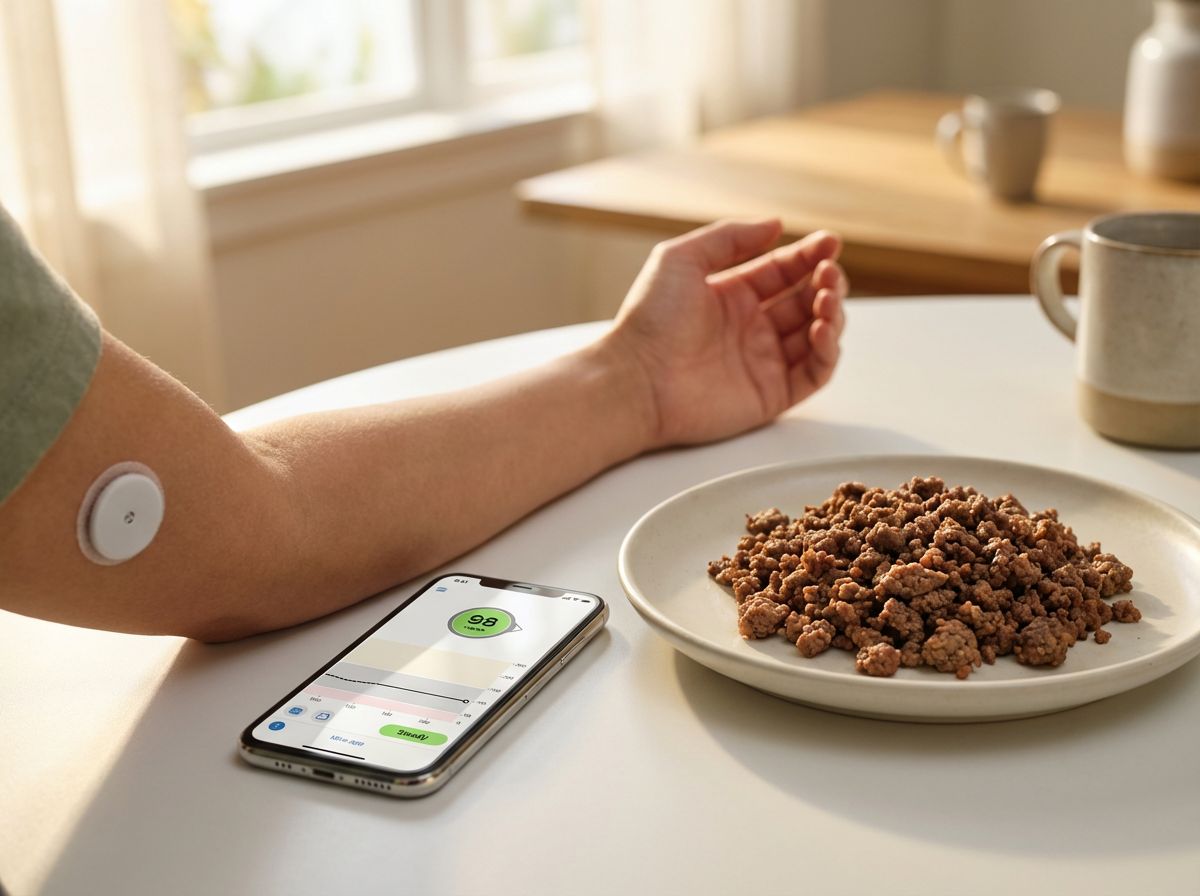
A continuous glucose monitor is a small sensor you stick on the back of your arm. It reads your interstitial glucose every few minutes and sends the data to your phone. That's it. It's not reading your insulin. It's not measuring ketones. It's not telling you how healthy you are. It's giving you one data stream, and that stream needs context.
Here's what I've seen work with my clients: treating CGM data as a conversation starter, not a verdict. Your glucose responds to food, stress, sleep, exercise, caffeine, and even the temperature outside. A single spike after a meal doesn't mean the meal was bad for you. A flat line all day doesn't necessarily mean everything is perfect.
What New Carnivore Eaters Typically See
If you strap on a CGM during your first two weeks of eating carnivore, you'll probably see some confusing things. The most common one is elevated fasting glucose in the morning. This is called the dawn phenomenon, and it happens because your liver dumps glucose to wake you up. On a low-carb diet, this effect can be more pronounced because your body is running on gluconeogenesis rather than dietary carbs.
New carnivore eaters also see adaptation spikes. Your body is switching fuel systems, and glucose regulation gets a little messy during the transition. I've had clients panic over fasting glucose readings of 100-110 mg/dL in their first month. The truth is, this is common and usually settles down. If you're coming from a standard diet and your bloodwork panels look otherwise normal, a few weeks of slightly elevated fasting glucose isn't a crisis.
Long-Term Carnivore Patterns
After three to six months on a strict carnivore diet, most people see remarkably stable glucose. We're talking flat lines for most of the day, with readings between 70 and 95 mg/dL. Post-meal spikes are minimal because you're not eating foods that cause rapid glucose elevation. A steak with butter might nudge your glucose up 10-15 points. A bowl of pasta would push it up 40-60.
This stability is one of the most striking things about carnivore CGM data. People who have spent years on blood sugar roller coasters suddenly see what metabolic calm looks like. It's powerful feedback, especially for anyone managing blood sugar concerns or type 2 diabetes risk.
When to Actually Worry
Consistently elevated fasting glucose above 110 mg/dL after three months of clean carnivore eating is worth investigating. So is glucose that doesn't come back to baseline within two hours of eating. Those patterns deserve a conversation with your doctor and probably a full metabolic panel.
But a one-off high reading? A spike after an intense workout? Elevated glucose during a stressful week at work? Those are normal physiological responses. Your body is doing exactly what it's supposed to do. The CGM is just showing you the machinery in action.
One more thing: I'm a health coach, not a physician. CGM data is useful for pattern recognition and self-awareness. It's not a diagnostic tool, and nothing in this article replaces medical advice from your doctor.
The CGM Protocol
By Marcus, Performance Coach
I'm going to save you months of obsessive glucose watching. You don't need to wear a CGM forever. You need to wear one during three specific windows, collect your data, and move on.
The Three Windows
Window 1: Baseline (Week 1-2 of carnivore). Wear it before you start or during your first week. This gives you a "before" snapshot. You'll see how your body handles glucose on your current diet. Record your average fasting glucose, your post-meal peaks, and your time in range (70-140 mg/dL). Write these numbers down. You'll want them later.
Window 2: The 90-Day Check. Put it back on at the three-month mark. Compare every metric to your baseline. Fasting glucose should be lower or stable. Post-meal spikes should be nearly flat. Time in range should be 95%+ on carnivore. If it's not, something needs adjustment.
Window 3: Any Diet Transition. Adding back carbs? Trying targeted carbs around training? Experimenting with fruit or honey? Wear the CGM. This is where you'll get the most valuable data. Your body's glucose response after months of carnivore will tell you exactly which foods work for you and which don't.
What to Track, What to Ignore
Track these four numbers:
- Average fasting glucose (morning, before eating)
- Post-meal peak (highest point within 2 hours of eating)
- Time to baseline (how long until you're back to pre-meal levels)
- 24-hour average glucose
Ignore these:
- Single-point readings that look weird (sensor error is real)
- Exercise spikes (glucose goes up during heavy training; that's normal)
- Night-time fluctuations (your body regulates glucose differently during sleep)
- Day-to-day variation of 5-10 mg/dL (meaningless noise)
Using CGM Data to Optimize
Here's the protocol. Eat your standard carnivore meals for three days without changing anything. Log what you eat and when. Then look at the data.
If your glucose stays flat regardless of meal timing, you're metabolically flexible. Keep doing what you're doing. If you see differences between morning and evening meals, that's useful. Some people handle larger protein loads better earlier in the day. The CGM will show you.
Protein-heavy meals (lean steak, chicken breast) will raise glucose more than fat-heavy meals (ribeye, bone marrow). This is because protein triggers gluconeogenesis. It's not a problem. But if you're trying to minimize glucose variability, adjusting your protein and fat ratios based on CGM feedback is one of the more practical optimizations you can make.
Cost-Benefit: Is It Worth It?
A Dexcom G7 or Libre 3 runs $75-150/month without insurance. That's real money. Here's my honest take: it's worth it for 2-4 weeks of targeted data collection. It's not worth it as a permanent accessory.
If you're an athlete trying to dial in performance nutrition, a month of CGM data during a training block can reveal patterns you'd never catch otherwise. If you're a healthy person eating ribeyes every day with stable energy and good bloodwork, you're spending $100/month to watch a flat line. Save the money.
The exception: anyone with a family history of diabetes, insulin resistance, or metabolic syndrome should consider longer monitoring. For those individuals, the data has clinical value beyond curiosity.
What the Community Is Actually Seeing
By Chloe, Community Manager
Okay, so I've been collecting CGM stories from carnivore communities for months now, and the patterns are fascinating. People love sharing their glucose data. It's become its own subgenre of carnivore content, and honestly, some of the real-world results are more convincing than any clinical study.
The Fasting Glucose Panic
Real talk: the number one CGM freak-out in carnivore groups is "My fasting glucose went UP since starting carnivore. Am I becoming diabetic?!" I see this post at least twice a week. And every time, the comment section fills up with experienced carnivore eaters saying the same thing: it's normal, it's temporary, calm down.
One community member shared her data from a full year of tracking. Her fasting glucose went from 88 on a standard diet to 105 in month one of carnivore, then gradually settled to 82 by month six. That pattern shows up again and again. The initial rise scares people, but the long-term trend is almost always downward. If you've seen carnivore tips on Reddit, you know the community has been talking about this for years.
The Carb Reintroduction Reveal
This is my favorite category of CGM posts. Someone eats strict carnivore for three to six months, gets metabolically stable, and then eats a "normal" meal at a family dinner or holiday. Rice, bread, dessert. The CGM goes haywire.
One guy posted his data from Thanksgiving. After four months of carnivore, his glucose averaged 85 all day. Then he ate stuffing, mashed potatoes, and pumpkin pie. His glucose spiked to 195. He said it was the most effective motivator he'd ever found. "The CGM doesn't lie" has become a community catchphrase for a reason.
But here's the nuance the community has learned: that exaggerated spike after reintroduction doesn't mean you're broken. Your body downregulates its insulin response when you're not eating carbs regularly. It's called physiological insulin resistance, and it's different from pathological insulin resistance. The spike looks dramatic, but it resolves. If you eat carbs regularly again for a few days, the response normalizes. The community figured this out by comparing notes, which is the kind of thing that makes carnivore vs keto discussions so much richer when people bring actual data.
Which CGMs the Community Recommends
Freestyle Libre 3 is the most popular choice by far. It's the cheapest option, the app is straightforward, and you can get it through several direct-to-consumer programs without a prescription in some regions. Community members report good accuracy and a comfortable 14-day wear cycle.
Dexcom G7 gets praise from the more data-obsessed members. It sends readings every 5 minutes (vs every minute for Libre), but integration with Apple Health and other tracking apps is smoother. It's pricier, and most people say it's overkill unless you have a medical reason for continuous monitoring.
Stelo by Dexcom is the newer over-the-counter option marketed to people without diabetes. Community feedback is mixed. Some love the lower commitment (15-day sensor, no prescription). Others say the app is too simplified and doesn't give enough raw data for serious tracking.
The consensus? Start with a Libre 3. Wear it for two weeks. If the data changes your behavior or gives you useful insights, consider a second sensor. If the line is flat and boring, congratulations. Your metabolism is doing its job. Take the win and move on.
The Unexpected Insights
Some of the most interesting community findings have nothing to do with food. People have discovered that poor sleep raises their fasting glucose by 10-15 points. That a stressful work call can spike glucose as much as a slice of bread. That cold exposure drops glucose temporarily. That coffee on an empty stomach creates a small but measurable bump.
These non-food insights are what make CGMs genuinely useful beyond diet validation. You start seeing your body as a system that responds to everything, not just what's on your plate. And for carnivore eaters who already have their diet dialed in, that's where the real learning happens.
A note from all three of us: Nothing in this article is medical advice. We're a health coach, a performance coach, and a community manager. We're sharing what we've learned and what the data shows, but your health decisions should involve your doctor. If you have diabetes, are on medication that affects blood sugar, or have any metabolic condition, please talk to a qualified medical professional before making changes based on CGM data. A glucose monitor is a tool for awareness, not a replacement for clinical care.