
This post may contain affiliate links. For educational purposes only, not medical advice. Details
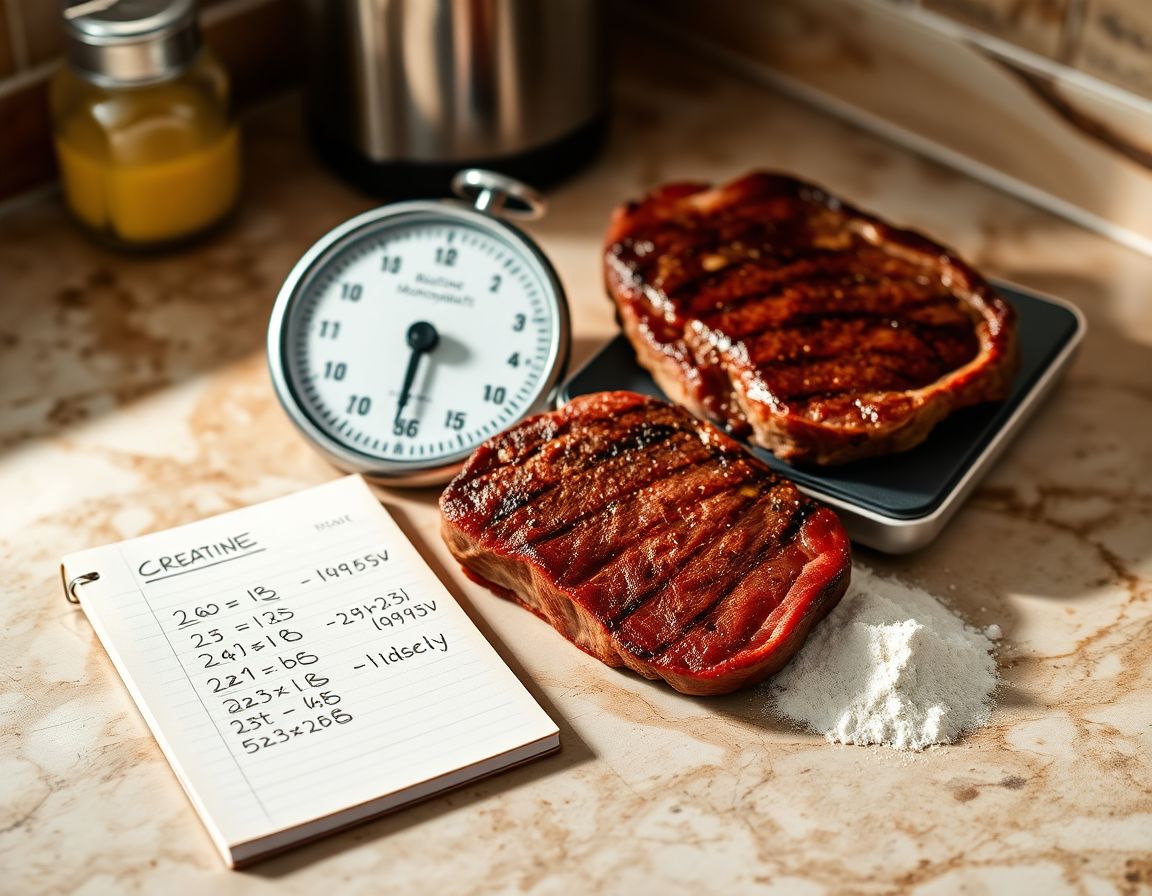
The "You Get Enough From Meat" Myth
I hear this one all the time. "I eat 2 pounds of beef a day. I don't need creatine." Sounds logical. Let's check the math.
Raw beef contains roughly 2 grams of creatine per pound. Cook it, and you lose about 30% of that to heat degradation. So your 2 pounds of steak gives you around 2.8 grams of creatine per day. Your body synthesizes another 1 to 1.5 grams on its own from amino acids in your liver and kidneys.
Total daily creatine from diet plus synthesis: roughly 4 to 4.5 grams. That's enough to maintain baseline stores if you're sedentary. But if you're training hard, your muscles burn through creatine phosphate faster than you can replenish it from ribeyes alone.
Here's the protocol-level truth: saturation matters more than intake. Research consistently shows that muscle creatine stores max out at about 160 mmol/kg of dry muscle. Most people eating carnivore sit around 120 to 130 mmol/kg. That 20-25% gap is free performance you're leaving on the table.
What Supplemental Creatine Actually Does
Creatine monohydrate is the single most studied sports supplement in existence. Over 500 peer-reviewed studies. The results aren't controversial anymore. They're just consistent.
- Strength: 5-10% increase in maximal effort output (1RM lifts, sprint power)
- Muscle volume: 1-2 kg lean mass gain in the first month, partly from intramuscular water, partly from increased training capacity
- Recovery: Faster phosphocreatine resynthesis between sets, meaning you can do more quality work per session
- Cognitive function: 10-15% improvement in short-term memory and mental fatigue resistance, especially under sleep deprivation or stress
That last point doesn't get enough attention. If you're stuck in a training plateau around week six, it might not be your programming. It might be your brain running low on phosphocreatine before your muscles do.
Who Actually Benefits From Adding It
Not everyone needs to supplement. Here's how I break it down with the people I coach.
Definitely supplement if you:
- Lift heavy 3+ times per week
- Do any sport with repeated explosive efforts (BJJ, sprints, CrossFit)
- Are over 40 and want to protect muscle mass and cognitive sharpness
- Eat less than 2 pounds of red meat daily
Probably fine without if you:
- Do only low-intensity movement (walking, yoga, light cycling)
- Eat 2+ pounds of red meat daily and don't train for performance
- Are primarily focused on fat loss, not strength gains
If you're working on body recomposition on carnivore, creatine becomes especially useful. The extra training capacity means more mechanical tension on muscle fibers, which drives recomp faster when protein intake is already high.
Loading vs. Maintenance: The Simple Protocol
There are two approaches. Both work. One is faster.
Option A: Loading phase (faster saturation)
- 20 grams per day, split into 4 doses of 5 grams, for 5 to 7 days
- Then drop to 3 to 5 grams per day for maintenance
- Full saturation in about 1 week
Option B: Straight maintenance (simpler)
- 5 grams per day from day one
- Full saturation in about 3 to 4 weeks
- No bloating, no GI issues, no fuss
I recommend Option B for most carnivore lifters. You're already getting 3 to 4 grams from your diet, so you're not starting from zero. Adding 5 grams on top of that gets you to saturation without the water retention spike that makes people think creatine is "bloating" them.
Timing doesn't matter much. Take it whenever it's convenient. With a meal, in water, mixed into bone broth. Consistency beats timing every single day. The only thing that matters is that you take it daily. Skip days and your stores drop back down.
The Carnivore-Specific Advantage
Here's something most supplement guides miss. Carnivore eaters actually respond better to creatine supplementation than people on mixed diets. Why?
Two reasons. First, your baseline creatine intake from meat is already higher than the average person's, which means your transport systems are primed. Second, the high protein intake on carnivore provides abundant methionine and glycine, the amino acids your body uses for endogenous creatine synthesis. You're giving your body every building block it needs to use the extra creatine efficiently.
This is the same reason muscle building on carnivore tends to outperform what people expect. The raw materials are all there. Creatine supplementation just removes the last bottleneck.
What to Buy (and What to Skip)
Creatine monohydrate. That's it. Don't overcomplicate this.
Skip creatine HCL, buffered creatine, creatine ethyl ester, or any "advanced" formula that costs 3x as much. None of them outperform plain monohydrate in head-to-head studies. Most of them have less research behind them.
Look for a product that's just creatine monohydrate with no fillers, no sweeteners, no added aminos. It should cost about $0.03 to $0.05 per gram. If you're paying more than $20 for 500 grams, you're overpaying.
One thing to watch on carnivore: some creatine products add maltodextrin or dextrose as a "transport" carb. You don't need it and you don't want it. The insulin spike from your protein-rich meals handles creatine uptake just fine.
Cognitive Benefits Worth Mentioning
Your brain uses about 20% of your body's total energy. It runs on ATP just like your muscles do. And it stores phosphocreatine the same way.
Studies show that creatine supplementation at 5 grams per day improves working memory, reduces mental fatigue, and may even protect against the cognitive decline that comes with aging. For anyone in a demanding job or anyone over 40, this is a meaningful benefit beyond the gym.
If you're someone who trains without carbs, as many keto and carnivore athletes do successfully, creatine becomes even more valuable. It provides an ATP buffer that doesn't depend on glycogen at all.
The Protocol Summary
Stop overthinking it. Here's exactly what to do.
- Buy: Plain creatine monohydrate, no fillers
- Dose: 5 grams per day, every day, no cycling needed
- Timing: Whenever you remember. With food is fine.
- Duration: Indefinitely. There are no long-term safety concerns in healthy adults across decades of research.
- Cost: About $0.15 per day. That's $4.50 per month for measurable performance gains.
The math doesn't lie. Your 2 pounds of beef gets you close, but "close" isn't the same as "optimal." For less than the price of a coffee per month, you fill the gap completely.
Not a Doctor. I've coached people and competed myself, so I know what works. But I'm not your doctor. If you have health issues or take meds, check with someone qualified. Everything here is based on what works in practice and what research supports. Your mileage may vary.