This post may contain affiliate links. For educational purposes only, not medical advice. Details
You've been told your whole lifting career that carbs drive muscle growth. Insulin spikes, glycogen supercompensation, anabolic windows—the entire bodybuilding industry runs on this narrative.
Here's what actually happens when you build muscle on carnivore.
The Protein Leverage Reality
Muscle protein synthesis responds to one primary signal: protein intake. Not carbs. Not insulin spikes. Protein.
The minimum effective dose: 1 gram per pound of GOAL body weight daily. A lifter whose goal weight is 180 lbs needs about 180g, and up to 1.2g per pound of goal weight if training is heavy. We use goal weight rather than current weight so the number does not inflate for a body you are trying to change. Split it across meals: 30-40g per meal beats one giant dose.
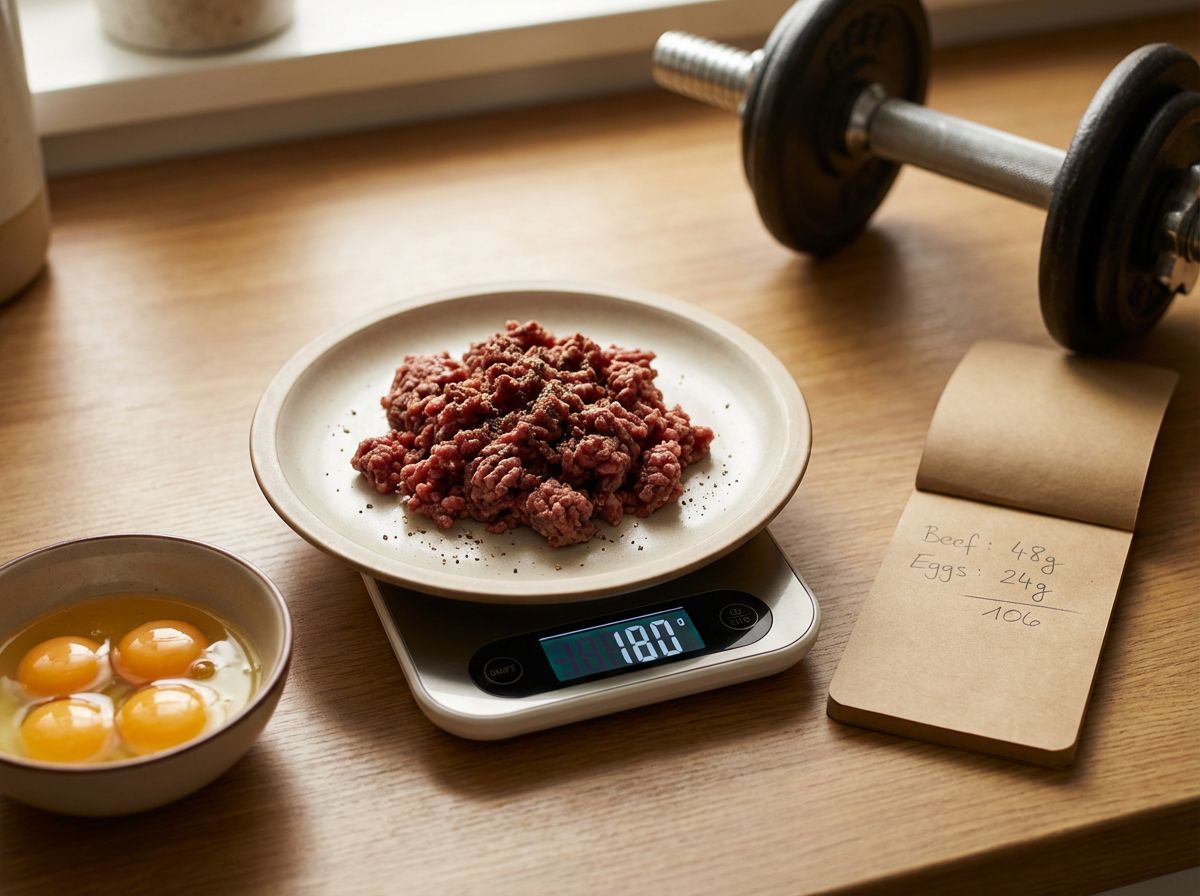
On carnivore, you're already there. 1 pound of beef = 100g protein. 4 eggs = 24g. You don't need to calculate or track obsessively because you're eating exclusively from the most protein-dense foods on earth.
Understanding strength gains without carbs starts with recognizing that protein—not glucose—drives the anabolic response.
Training Volume Protocol
Progressive overload works identically on carnivore. The difference is in your fuel source, not your training stimulus.
Hypertrophy rep ranges remain the same:
- Compound lifts: 6-12 reps
- Isolation work: 10-15 reps
- Total weekly volume: 10-20 sets per muscle group
What changes is your capacity to recover between sets. Weeks 1-2 on carnivore, expect longer rest periods. Your creatine phosphate system adapts by week 3-4.
Sample weekly split for muscle growth:
- Monday: Upper Push (chest, shoulders, triceps)
- Tuesday: Lower (quads, hamstrings, glutes)
- Wednesday: Rest or light activity
- Thursday: Upper Pull (back, biceps, rear delts)
- Friday: Lower (deadlift variation, accessory work)
- Weekend: Active recovery
Volume drives growth. Frequency allows recovery. Carnivore doesn't change this equation.
The Adaptation Timeline
Here's what actually happens when you switch to carnivore mid-training block:
Weeks 1-2: Strength dip of 10-15%. Your body is transitioning fuel systems. Glycogen depletes. Fat oxidation ramps up. This is temporary.
Weeks 3-4: Strength stabilizes. You're no longer weaker, but you're not stronger yet. Recovery between sets improves.
Weeks 5-8: Strength returns to baseline, then exceeds it. Lifters commonly report PRs by week 6-8. Muscle fullness returns as intramuscular water rebalances.
Week 12+: Full adaptation. Training performance matches or exceeds pre-carnivore levels.
The key: don't panic and quit during weeks 2-4. The adaptation is real and predictable.
Bulking vs Cutting on Carnivore
Body composition changes follow energy balance. Carnivore doesn't override thermodynamics.
To build muscle (bulk):
- Eat 1.2-1.5g protein per lb bodyweight
- Add fat to surplus calories: fattier cuts, butter, tallow
- Target 300-500 calorie surplus daily
- Expect 2-4 lbs gained per month (half muscle, half fat)
To lose fat while maintaining muscle (cut):
- Keep protein at 1g per lb of goal body weight
- Reduce fat intake: leaner cuts, trim excess
- Target 300-500 calorie deficit daily
- Expect 1-2 lbs lost per week
The advantage on carnivore: protein is so satiating that cutting feels less miserable. No blood sugar crashes. No cravings.
Meal Timing Around Training
The anabolic window isn't as critical as bodybuilding magazines claim. But meal timing still matters for performance and recovery.
Pre-workout (60-90 minutes before):
Moderate protein, moderate fat. This prevents training on an empty stomach without causing digestive distress mid-set.
Example: 6 oz steak, 2 eggs. Not a full meal, but enough fuel.
Post-workout (within 2 hours):
Your largest meal. High protein, high fat. This is when muscle protein synthesis peaks.
Example: 12 oz ribeye, 4 eggs, butter. Go big here.
If you're doing intermittent fasting, train in your eating window. Fasted training on carnivore works for fat loss, but it's suboptimal for muscle growth.
Electrolytes and Performance
Carnivore is diuretic. You excrete more sodium and water, especially in the first 2-4 weeks.
Low sodium = weak lifts. It's that simple.
One check before you add electrolytes. If you take a daily pill for blood pressure or your heart, a water pill, or anything to do with your kidneys, talk to your doctor or pharmacist before you add potassium from a supplement, from a salt substitute like Lite Salt or No Salt, or from a daily electrolyte packet. Some of those medicines already hold potassium in your body, so extra on top is the problem rather than the help. Same conversation if a blood test has ever flagged your potassium, your sodium, or your kidney function.
This section used to list daily milligram targets. I've taken them down rather than quietly swap in smaller ones, because one number aimed at every reader is wrong for the people it can hurt. Salt your food and salt it to taste, heavier on days you sweat hard. Meat brings potassium and magnesium with it. If you're still cramping after a week of salting like you mean it, that's a blood panel, not a bigger scoop.
Add salt to your pre-workout meal. Add salt to your post-workout meal. If you cramp mid-set or feel weak, you need more sodium.
For a deeper dive on managing electrolyte balance, check our complete protocol guide.
What About Muscle Fullness?
Glycogen gives muscles that pumped, full look. On carnivore, glycogen stores run lower.
This doesn't mean you're losing muscle. It means you're carrying less water in your muscles.
By week 8-12, intramuscular water rebalances. Your muscles look full again, just without the glycogen. The visual difference is minimal once you're fully adapted.
If you're a competitive bodybuilder prepping for a show, you can strategically carb-load 24-48 hours out. But for general muscle building, it's irrelevant.
The Bottom Line
Building muscle on carnivore requires:
- 1g protein per lb of goal body weight daily, up to 1.2g when training hard
- Progressive overload with 10-20 sets per muscle group weekly
- Patience through the 2-4 week adaptation dip
- Calorie surplus for growth, deficit for cuts
- Steady sodium: salt your food to taste, and more of it on hard training days
You don't need carbs to build muscle. You need protein, training stimulus, and recovery. Carnivore delivers all three.
The bodybuilding industry built its nutritional dogma around carbs because supplement companies can't sell you beef. The physiology works without them.
One line on cutting that matters more than the rest of this: when you drop calories, don't drop fat to do it. Protein high and fat scraped to nothing is the one configuration on carnivore that actually makes people sick. Keep roughly a gram of fat for every gram of protein once you account for what you're pulling off your own frame, and read the fat floor breakdown before you run a deficit.
Not a doctor. I've coached people and competed myself, so I know what works in practice. But I'm not your doctor. If you have kidney or liver issues, or you take medication, protein and sodium targets are a medical conversation before they're a nutrition one. Nausea, weakness, or headaches that don't clear within a day of adding fat back need a doctor's eyes, not a spreadsheet. Your mileage may vary.