This post may contain affiliate links. For educational purposes only, not medical advice. Details
The short answer: 0.8 to 1 gram per pound of your goal weight
If you're a woman between 45 and 70 eating in a calorie deficit, aim for 0.8 to 1 gram of protein per pound of your goal body weight. Not your current weight. Your goal weight. So if you weigh 190 and you'd like to get to 150, you're aiming for 120 to 150 grams of protein a day.
Most women I talk to in this age range are eating half that. They're at 60 or 70 grams and wondering why the scale moves but they feel softer, weaker, and more tired than they expected. That gap is the whole problem. Here's why it matters more after 50 than it ever did at 30, and what that number actually looks like on a plate.
Why your muscles stopped listening
There's a thing researchers call anabolic resistance. It sounds technical. It's not.
When you eat protein, your body breaks it into amino acids and uses them to repair and rebuild muscle. In your twenties, a modest amount of protein flipped that switch easily. A couple of eggs and your body got the message.
After about 50, that switch gets stiff. Your muscles need a bigger push to respond to the same signal. Same food, weaker response. It's part hormonal, part inflammation, part just less muscle to work with in the first place. The practical result is simple. You need more protein now to hold onto what you have than you needed at 35 to build it.
Adults lose roughly 3 to 8 percent of their muscle per decade after 30, and the rate picks up after 60. Add a calorie deficit on top of that and you speed things up. When people lose weight without enough protein, a meaningful chunk of what comes off is lean tissue, not just fat. That's how someone drops 25 pounds and ends up smaller but weaker, with a metabolism that's slower than when they started.
Protein is the thing that changes that math. Eat enough of it in a deficit and most of what you lose is fat.
Run your own number
Take your goal weight and multiply it by 0.8 for the low end and 1.0 for the high end.
- Goal weight 140 pounds: 112 to 140 grams a day
- Goal weight 150 pounds: 120 to 150 grams a day
- Goal weight 165 pounds: 132 to 165 grams a day
Start at the low end. If you're consistently hitting it and still feel weak or you're losing weight fast, move up. There's no prize for being at the top of the range if the bottom is working.
One note on goal weight. If your goal weight is more than about 50 pounds below where you are now, use a nearer target instead. Something like 20 pounds down from today. You can recalculate as you go. Using a very distant goal weight can leave you undereating protein while you've still got a lot of body to feed.
If you'd rather not do the math by hand, the free macro calculator at /calculator.html will run it with your age and activity level built in. Some people like seeing the number spelled out with their calories next to it. Either way works. The math above is the same math.
What 130 grams actually looks like
This is where the number stops being abstract. Here's a real day at roughly 130 grams, using cooked weights.
- Breakfast: 3 eggs and 3 slices of bacon. About 27 grams.
- Lunch: 6 ounces of cooked ground beef, 85/15. About 44 grams.
- Dinner: 8 ounces of cooked ribeye. About 57 grams.
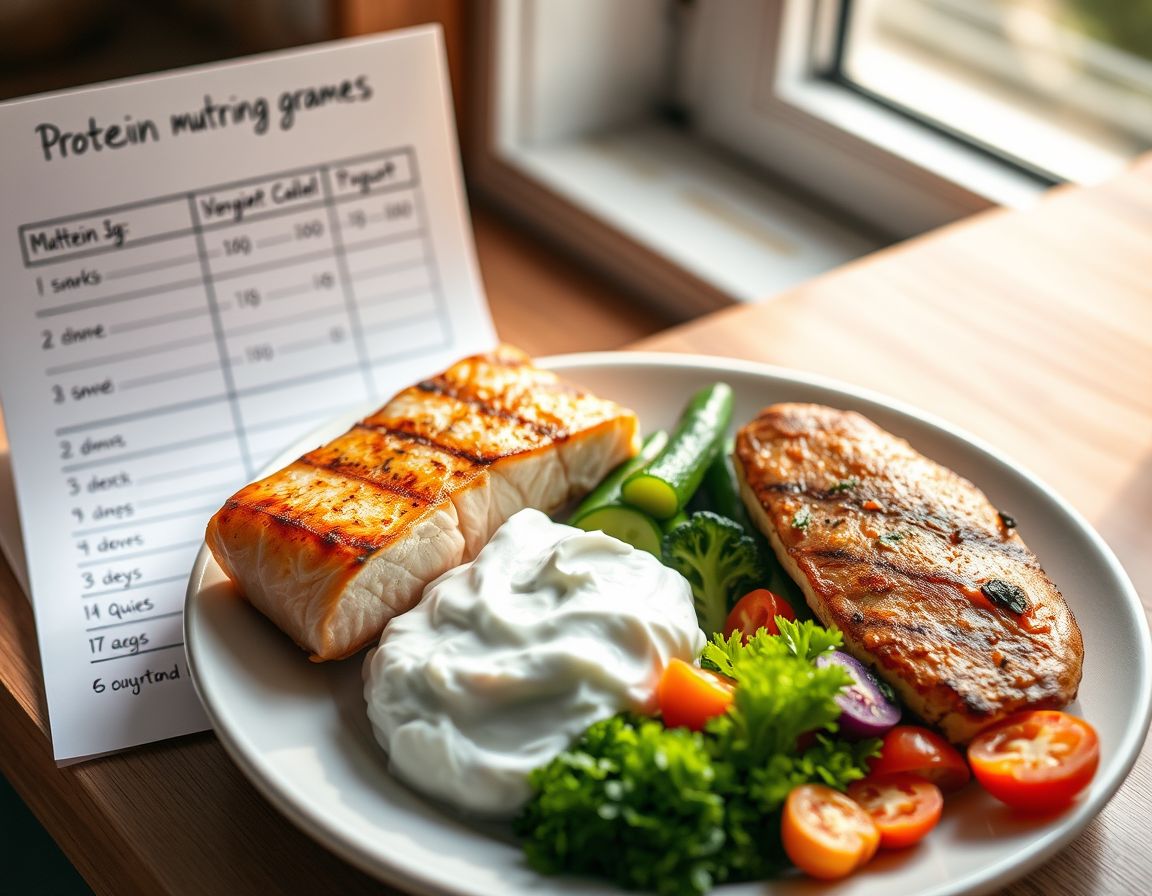
That's 128 grams across three meals. No shakes, no powders, no weighing every bite. Three normal carnivore meals.
Some rough numbers worth memorizing so you can eyeball it:
- One large egg: 6 grams
- 1 ounce of cooked beef, pork, chicken, or fish: roughly 7 grams
- 1 ounce of hard cheese: 7 grams
- A 6 ounce steak or burger patty: 40 to 45 grams
- A 6 ounce piece of salmon: about 38 grams
The ounce rule is the one that does the most work. Seven grams per cooked ounce of meat gets you close enough on almost anything.
Spread it across the day
Here's the part most people skip. Because of that stiff switch we talked about, a big protein dinner and two small meals doesn't do the same job as three solid meals.
Aim for at least 30 to 40 grams at each meal. That's roughly a 5 or 6 ounce portion of meat. Below about 30 grams, an older body often doesn't get a strong enough signal to hold muscle. That's why 40 grams at breakfast beats 15 grams at breakfast even if your daily total is identical.
If you're eating two meals a day, which plenty of people do on carnivore, split your total in half and make sure each one is substantial. Two 65 gram meals will do the job. Two meals where one is 90 grams and the other is 40 will do it less well.
What to expect
Give it three weeks before you judge it. Most people notice a few things in that window.
Hunger drops first, usually within the first week. Protein is the most filling thing you can eat, and getting to 130 grams tends to make the afternoon snack urge disappear on its own. Strength in daily things comes next. Carrying groceries, stairs, getting up off the floor. Those get easier before the scale shows much.
The scale may move slower than it would on a lower protein plan. That's not failure. That's you keeping muscle instead of burning it. What you want is the tape measure moving and your clothes fitting differently, not just a lower number.
Track your protein for two weeks so you know what your normal actually is. Almost everyone guesses high. Once you see it in writing, adjusting is easy.
I'm not a doctor. I've coached people through this and done it myself, but I'm not your doctor. If you have kidney disease, liver disease, or you take medications, especially blood pressure meds, diuretics, or diabetes medication, talk to your doctor before you make a big change to how you eat. Higher protein is well tolerated by healthy kidneys, but a diagnosed kidney condition changes the answer. Get it cleared first.
Pick your goal weight. Multiply by 0.8. Split it across your meals. That's the whole protocol.