
This post may contain affiliate links. For educational purposes only, not medical advice. Details
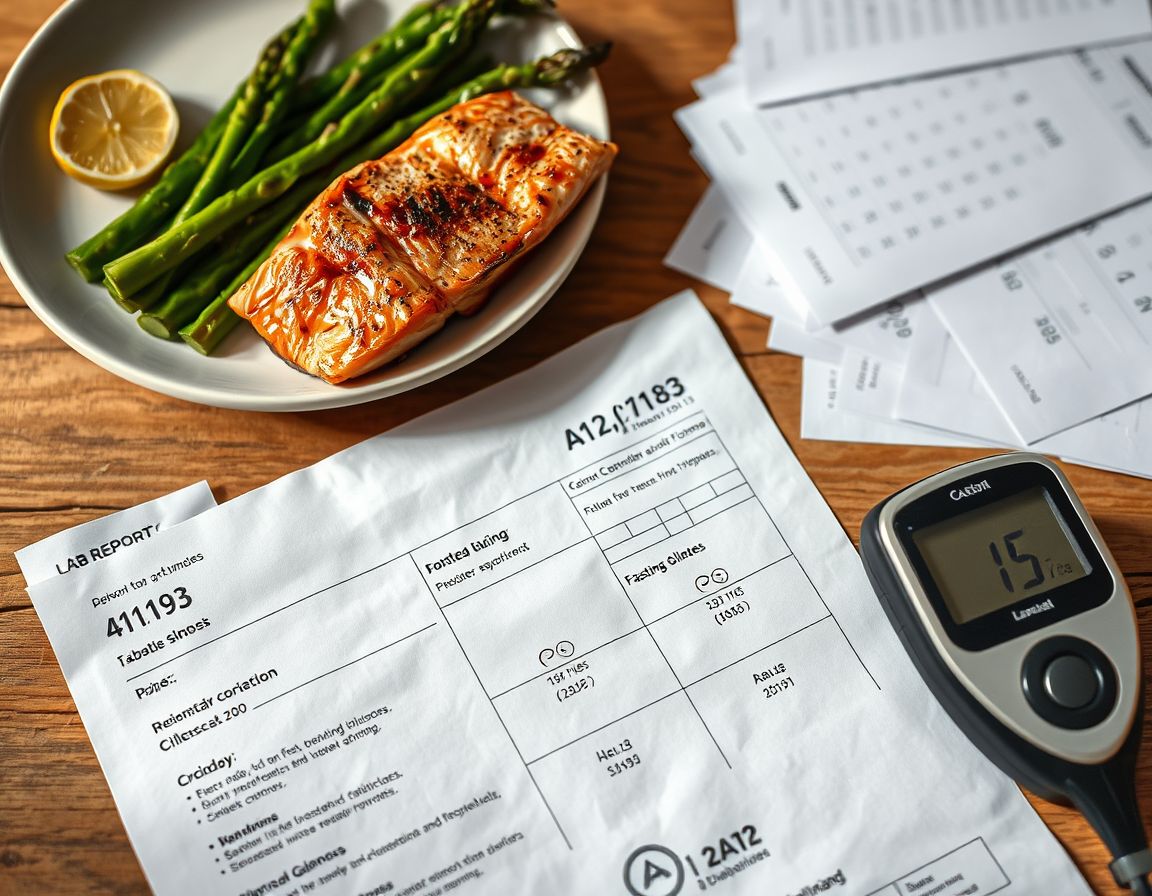
The short answer
If you start carnivore today and get labs drawn in 90 days, your A1c will very likely be lower. How much lower depends on where you started. People coming in around 5.7 to 6.4 percent, the prediabetic range, often land somewhere between 5.0 and 5.6. People starting higher, in the 7s or 8s, tend to see bigger absolute drops, sometimes a full point or more. People who were already at 5.2 may barely move, because there isn't much room.
Here's the part nobody warns you about. Your A1c drop will lag behind your actual blood sugar improvement by weeks, and your fasting glucose may sit flat or even creep up a few points while it happens. That combination scares people into quitting right before the labs catch up. So let's go through the biology, then the numbers worth watching.
Why A1c is always looking backward
A1c isn't a blood sugar reading. It's a measure of how much glucose has stuck to the hemoglobin inside your red blood cells. Sugar bonds to those cells slowly and permanently, so the more sugar floating around, the more coated they get.
Red blood cells live about 120 days. Your A1c is essentially a survey of everyone in that population, including cells that were formed back when you were still eating toast. That's why the number moves slowly.
The weighting isn't even, though, and that's good news. Roughly half of your A1c reflects just the past 30 days. About a quarter comes from the 30 to 60 day window, and the rest from the older cells. So a 90 day draw captures most of your dietary change, but not all of it. If you test at 90 days and want to know your true new baseline, test again at six months. It's usually lower still.
Why fasting glucose can rise while everything's improving
This trips up almost everyone. You cut carbs to near zero, and your morning fasting glucose reads 98, then 103, then 107. It feels like the diet is failing.
What's usually happening is called physiological insulin resistance, sometimes called adaptive glucose sparing. When you're running on fat and ketones, your muscles stop competing for glucose. They don't need it. So your body deliberately keeps a small pool of glucose in circulation and reserves it for the tissues that require it, mainly your brain and red blood cells. Your liver makes that glucose itself. You don't have to eat it.
The tell is what else is going on. In physiological insulin resistance, fasting insulin is low, triglycerides are low, and A1c is falling. In actual metabolic disease, insulin is high, triglycerides are high, and A1c is climbing. Same glucose number, opposite meaning. This is why a single fasting glucose reading is close to useless on its own.
One practical note. If you're getting labs drawn, don't do a long fast, a workout, or a stressful commute right before. Cortisol raises glucose. I've seen morning readings shift 15 points based on nothing but the drive to the clinic.
If you take glucose-lowering medication, stop and call your doctor first
This is the part I'd underline twice if I could. Cutting carbs lowers blood sugar quickly, often within days. If you're taking medication that also lowers blood sugar, the two effects stack, and you can end up hypoglycemic.
- Insulin carries the highest risk. Doses calculated for your old carb intake can become far too much within 48 hours.
- Sulfonylureas like glipizide, glyburide, and glimepiride also drive blood sugar down whether or not you've eaten. Real hypoglycemia risk.
- Metformin on its own rarely causes lows, but doses often need revisiting as your numbers change, and it's frequently prescribed alongside something else.
- SGLT2 inhibitors like empagliflozin or dapagliflozin deserve a specific conversation, because combining them with very low carb intake has been linked to ketoacidosis even at normal glucose levels.
Medication use and diagnosed conditions require professional medical management. Do not alter your treatment plan based on general information. Book the conversation before you change your eating, not after, and ask your doctor how they want you monitoring at home during the first few weeks.
What to actually track at 90 days
Ask for more than A1c. The full picture costs very little extra and tells you far more.
- A1c, for the 90 day trend.
- Fasting insulin, which most doctors won't order unless you ask. Pair it with fasting glucose to calculate HOMA-IR, the number that actually tracks insulin resistance.
- Triglyceride to HDL ratio, a cheap and useful proxy for metabolic health. Lower is better.
- Waist measurement, taken yourself, monthly. It often moves before the scale does.
If you want the day to day picture instead of a snapshot, a continuous glucose monitor for two to four weeks is genuinely informative. You'll see your post-meal response and your overnight pattern, which no single lab draw can show you.
One more thing that quietly affects all of this. Getting enough protein keeps you full, protects muscle while you lose weight, and steadies your energy, and most women I talk to in the 45 to 70 range are undereating it without realizing. If you've never checked your target, our free macro calculator at /calculator.html will give you a starting number in about two minutes.
When A1c lies to you
A1c assumes your red blood cells live a standard 120 days. When they don't, the number misleads.
I have beta thalassemia minor, an inherited blood condition I was born with. My red cells turn over faster than average, which means they spend less time collecting sugar, which means my A1c reads artificially low. It always has. Any blood condition that shortens red cell lifespan does this, including other anemias and recent blood loss.
It runs the other way too. Iron deficiency anemia can push A1c artificially high, because those cells stick around longer than usual. If your A1c doesn't match how you feel or what your glucose readings show, ask for a CBC and a ferritin level before drawing conclusions.
A realistic timeline
Weeks one through three, blood sugar readings start dropping but A1c hasn't budged. Weeks four through eight, fasting glucose may plateau or tick up while post-meal spikes flatten out. Weeks eight through twelve is when the A1c drop shows up on paper.
Ninety days is a checkpoint, not a verdict. Everyone's baseline is different, and what works for most may not work for you, especially if you have underlying health conditions. Get the labs, look at the trend, and take the whole panel to your doctor rather than one number in isolation.
I'm not a doctor. I've researched this deeply and worked with many people, but I'm not your doctor. If you take insulin, a sulfonylurea, metformin, or any other glucose-lowering medication, you need to talk with your physician before you cut carbohydrates, not after. The drop in blood sugar can be fast, and combined with medication it can cause dangerous hypoglycemia. Everything I write here is educational, based on research and on what I've seen work. Your situation might be different.