
This post may contain affiliate links. For educational purposes only, not medical advice. Details
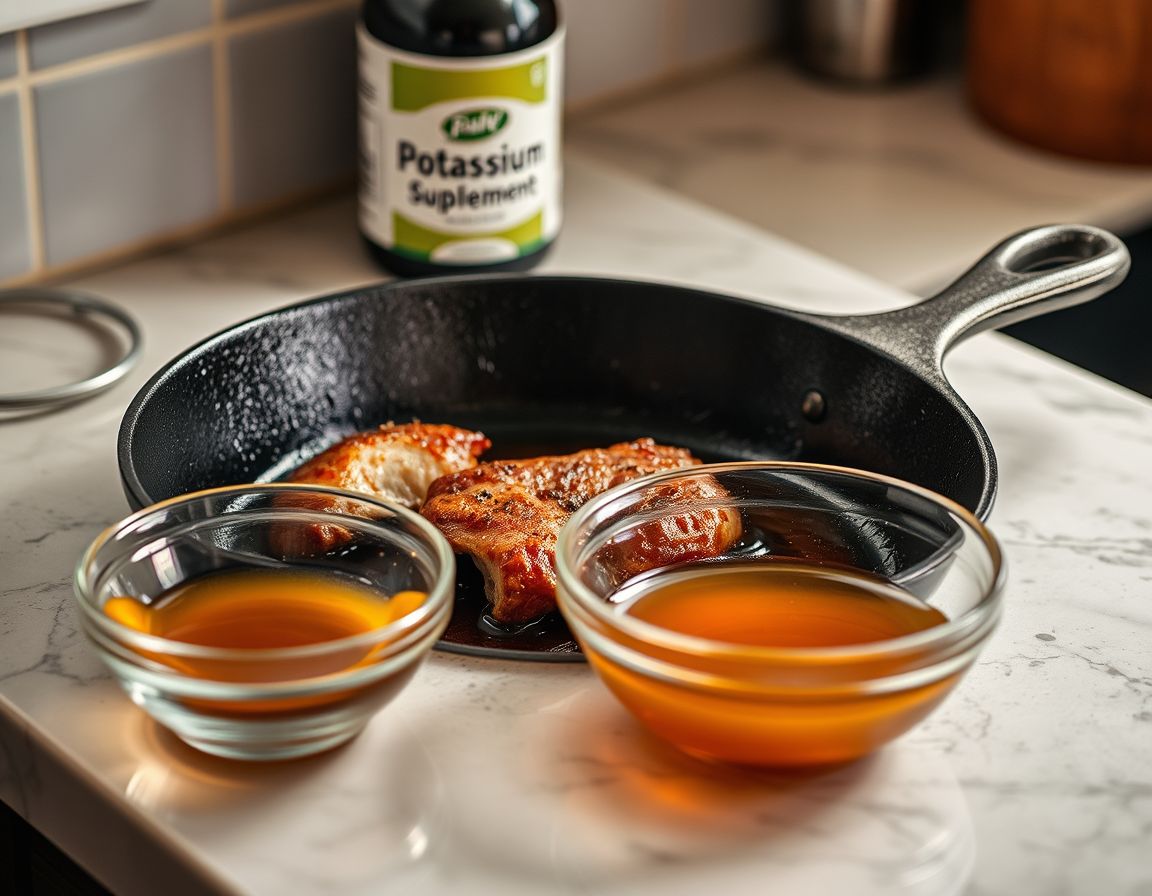
Here's the short answer. On carnivore, you get your potassium from meat, and you get it by eating enough of it at every meal. A 10 ounce ribeye gives you roughly 700 to 800 mg. Three meals in that range, plus eggs and whatever pan juices or broth you keep instead of pouring down the sink, put far more potassium on your plate than a 99 mg tablet holds. That's where the potassium in this way of eating comes from. It's a difference in scale, not a verdict on whether your own intake is where it should be.
You've probably seen a daily potassium figure quoted for adults somewhere. Those are population reference figures, drawn from what healthy groups tend to take in. They aren't a personal target, and they don't apply the same way to someone whose kidneys or medications change how potassium leaves the body. So I'm not going to hand you a number to chase. The comparison worth making is the size of a pill next to the size of a meal.
Most potassium tablets on the shelf hold 99 mg. That's roughly what sits in an ounce of beef, a bite or two of that ribeye. A capsule isn't a smaller version of a meal. It's a rounding error next to one. That gap isn't a scheme to sell more bottles, and it isn't a limit the FDA puts on supplements either. It's a serving size the industry settled on for itself, and there's some real history behind it.
Read this part before anything else
If you take a blood pressure medication, a diuretic, an ACE inhibitor or an ARB, or you have any kidney impairment, do not add potassium on your own. Not pills, not salt substitutes, not bulk powder off the internet.
Those medications change how your body handles potassium, and several hold onto it on purpose. Your kidneys clear the excess, so when they aren't working at full capacity, potassium builds up instead of leaving. Potassium that climbs too high is genuinely dangerous, and the first real sign can be a heart rhythm problem rather than a symptom you'd notice.
This isn't me being overly cautious. If that's you, potassium is a conversation with your prescriber and a blood test, not a decision you make in a supplement aisle. There's more on that in the guide to carnivore with health conditions and medications.
Why the pills are so small
Not because a regulator capped them. That's the part almost everyone repeats, and I had it wrong on this page until I went back to the source. Many supplement makers hold potassium to 99 mg per serving because the industry settled on that figure for itself, and it stuck.
The convention didn't come out of nowhere. Concentrated solid potassium has a history of causing trouble. It can irritate and damage the gut lining as it dissolves, and taking on a lot of potassium quickly can affect heart rhythm in people whose kidneys or medications can't keep up. That history is also where the FDA did act, and the actual rule is narrower than the version people pass around. Certain oral potassium chloride drug products delivering more than 99 mg were ruled unsafe after being linked to small bowel lesions, and some potassium salts above 99 mg per tablet have to carry a warning about it. Those are drug products. The FDA hasn't ruled on whether dietary supplements above 99 mg need a warning at all. No warning rule is not the same as an established safe level. It doesn't set one, and it doesn't make a larger serving appropriate.
Higher dose potassium does exist. Sometimes a doctor prescribes it, and when that happens the amount and the follow up are built around that person's own medical picture. Monitoring can include blood tests where that is clinically appropriate. Concentrated potassium also sits on open shelves as bulk powder and as potassium based salt substitutes, no prescription involved. Easy to buy is not the same as suitable for you to take, and it settles nothing about how much belongs in your body. The difference between those two situations was never the size of the number. It's whether anyone is watching what it does in you.
Which is why 99 mg tells you nothing about yourself. It isn't a dose worked out for you, it isn't a line where everything underneath becomes safe, and it isn't a quiet hint that two or three would be fine. It describes what a manufacturer decided to put in a capsule, and that's all it describes.
So the pills aren't useless. They're just not built to be your main source. Meat delivers potassium in the hundreds of milligrams per serving, and a capsule delivers it in double digits. That is the whole reason a shelf can't be where your potassium comes from.
Meat is a much better potassium source than most people think
Public nutrition advice fixates on bananas and potatoes, so meat gets skipped entirely. Gram for gram, that's backwards. Here's roughly what you get per 100 grams of cooked food:
- Pork loin: about 400 mg
- Salmon: about 380 to 420 mg
- Beef: about 270 to 320 mg depending on cut
- Chicken: about 230 to 340 mg depending on cut
- Banana: about 360 mg
Pork and salmon beat banana outright. Beef is close behind. And nobody sits down to 100 grams of steak, which is about three and a half ounces. Portion size closes the gap, and that's the part the banana advice never accounts for.
Two things help you keep what's there. Cooking in water pulls potassium into the liquid, so drink the broth or spoon the pan juices back over the plate. And eat enough total food. A lot of the low potassium symptoms I hear about are really undereating in disguise, especially in the first couple months when appetite drops hard. If you're unsure where your portions sit, our free macro calculator gives you a protein and calorie starting point.
What running low actually feels like
Low potassium shows up as muscle cramps and twitching, unusual weakness, fatigue that sleep doesn't fix, constipation, and sometimes a fluttering or skipped heartbeat.
The catch is that low sodium and low magnesium look almost identical, and so do plenty of things that aren't mineral problems at all. There's a real mechanism behind the early weeks: you've dropped processed food, insulin has fallen, and your kidneys start dumping sodium and water fast. Knowing that is useful. It still doesn't tell you which of these is happening in you, which is why the list above is a reason to look into it rather than a diagnosis.
And if your main symptom is a fluttering or racing heart, please don't self-treat it with potassium. That's the one where guessing wrong matters most. I wrote about when palpitations are worth a call to your doctor, and it's worth reading first.
Salt substitutes exist. I'm not giving you a dose.
You'll see people recommend salt substitutes and half sodium, half potassium table salts. These are largely potassium chloride, and yes, people use them as everyday table salt.
That's as far as I'll go. I won't tell you how much to use, and I won't point you at bulk potassium chloride as a money saver. Bought that way it's a supplement with no label, no dose, and nobody checking your blood level.
Cream of tartar is the other route people mention. It's potassium bitartrate, and it does carry a meaningful amount per teaspoon. Same rules apply. If you're on any of the medications above, it goes past your doctor first.
Sodium and magnesium: there isn't one number
Potassium doesn't work alone. Sodium and magnesium sit alongside it, and this is usually the point where an article hands you a daily figure for each one. I'm not going to, and it isn't squeamishness. A figure like that would be wrong for a large share of the people reading this page, and the ones it would be most wrong for are the least likely to know it.
Start by separating two ideas that get blurred together. Food composition is what's already inside the meat, the eggs, the pan juices and the salt you cook with. Supplementation is what you add on top of that as a pill, a powder or a salt substitute. A nutrition label describes the first, and you can look it up while you're standing in the shop. The second is a decision about your own body, and it has to account for your kidneys, your prescriptions and your blood work. Most of the bad advice on this subject comes from reading a figure for one and applying it to the other.
Sodium is the clearest example of why a single figure doesn't exist. What a person loses in a day moves with how much they sweat, the climate they live in, how hard they train, how much processed food they stopped eating, and whether they take a medication that changes how the kidneys handle salt. Kidney function itself moves it again. Those aren't small wobbles around one shared figure. They're the whole spread, and two people at the same dinner table can sit at opposite ends of it.
The second trap is using how you feel as a calculator. Fatigue, cramps, headaches and a fluttering heartbeat are real, and they're worth taking seriously. What they can't do is tell you which mineral is involved, or how much of it belongs in you. Every one of those has a long list of possible causes, and several of those causes get worse when the response is a guess at minerals. A symptom is a reason to ask a question. It isn't the answer to one.
What you can get good at instead is labels. Nobody teaches this, and it takes about a minute in the shop.
- On a food package, find the serving size first. The sodium and potassium figures printed on the panel describe that serving, not the portion on your plate, and the two are often nothing like each other. If the label also gives a per 100 gram column, use that one when you're comparing two products, because it's the only honest way to line them up.
- On a supplement or a salt substitute, read the Supplement Facts panel before it goes in the basket. Look at the serving size and at how many capsules or scoops that serving actually is, then at the percent Daily Value column. Then read the ingredient line underneath it. Salt substitutes and so-called low sodium salts are mostly potassium chloride, and the front of the pack rarely says so plainly.
- Keep a plain written record for a few days. What you ate, what you added, how you slept, how you felt. Written down, not remembered. It turns a vague story into something a clinician can read in half a minute, and more often than people expect, it shows that the real problem was not eating enough food.
If you want an actual figure for yourself, it comes from someone who can see your blood work and your prescription list. A pharmacist can go through what you're taking, and your prescriber can order the panel. The section below has the three questions worth bringing.
Sodium, potassium and magnesium move together, which is why they get discussed as a set rather than one at a time. Our sister site covers how the three interact in keto electrolytes: sodium, potassium, magnesium.
Menopause shifts the picture again. Sweats change what you lose in a day, which is one more reason a general figure won't fit a specific person. Hot flashes on carnivore covers that overlap.
What to ask your doctor
Ask for a basic metabolic panel, which includes potassium, sodium, and kidney function. Ask specifically whether any of your current prescriptions raise potassium or hold onto it. And ask whether it's safe for you to use a salt substitute at the table.
Three questions, two minutes, and guessing turns into knowing. Medication decisions belong to your prescriber. Our job is telling you what to measure and what to ask.
I'm not a doctor. I've researched this deeply and worked with a lot of people, but I'm not your doctor. If you have health conditions, take medications, or need specific guidance, talk to someone who knows your full medical picture. Everything here is educational, based on research and what I've seen work. Your situation might be different.