This post may contain affiliate links. For educational purposes only, not medical advice. Details
Sometimes Less Is the Only Way Forward
A reader emailed me last month with a list of symptoms that I've seen dozens of times. Joint pain that wouldn't resolve. Persistent bloating after every meal. Skin rashes that came and went with no apparent pattern. Brain fog that made her feel like she was thinking through wet cotton. She'd tried low-carb. She'd tried paleo. She'd even tried standard carnivore for three weeks, but she was still eating pork, eggs, and butter alongside her beef, and nothing was improving fast enough.
"What am I doing wrong?" she asked.
She wasn't doing anything wrong. She just hadn't eliminated enough.
What the Lion Diet Actually Is
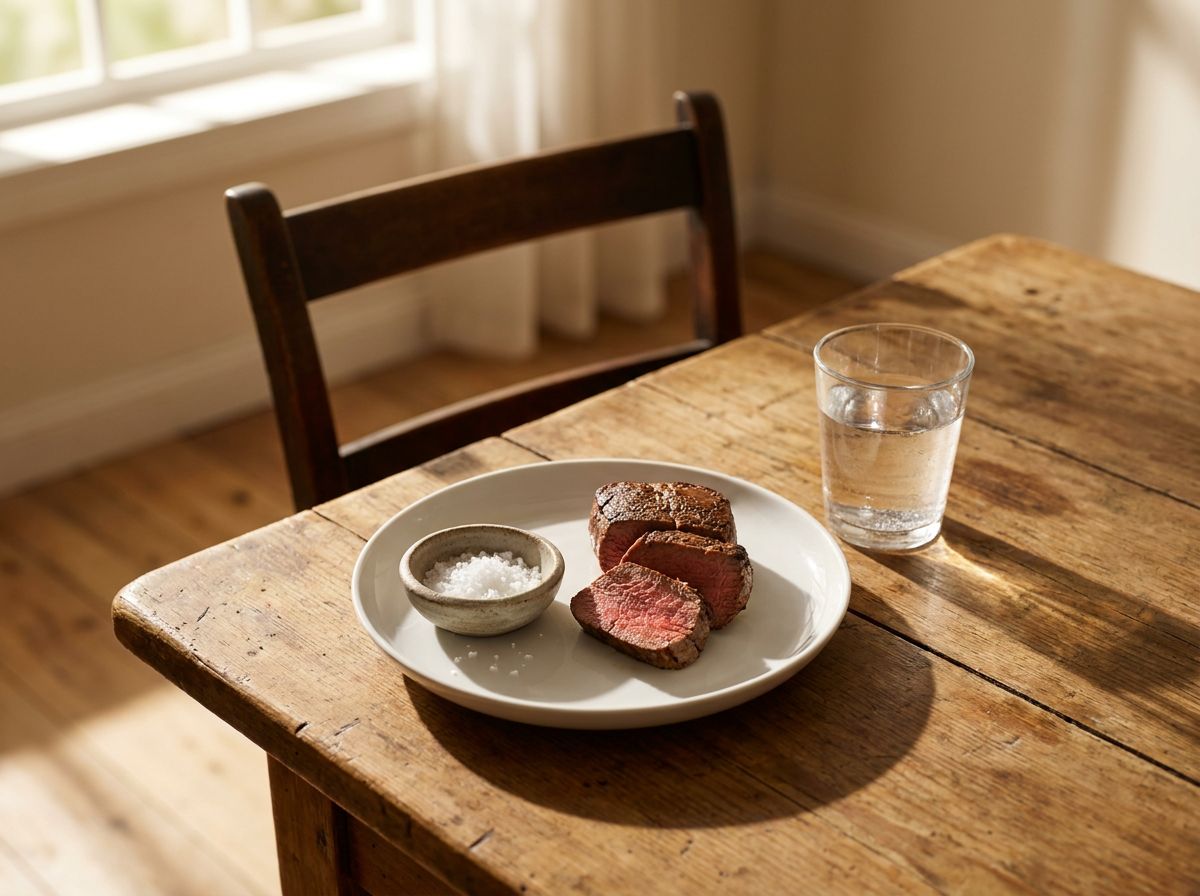
The lion diet is the most stripped-down version of carnivore eating. Beef, salt, and water. That's it. No pork. No chicken. No eggs. No dairy. No spices. No coffee. Nothing except ruminant meat (typically beef), salt for electrolytes, and water for hydration.
It sounds extreme, and I won't pretend it doesn't. When I first encountered it, I thought it seemed unnecessarily restrictive. But after watching what happens when people with stubborn inflammatory symptoms try it, I changed my mind. There's a specific kind of person who needs this level of elimination, and for them, it's not extreme. It's the first thing that actually works.
Who It's Actually For
The lion diet isn't a weight loss hack or a performance protocol. It's a diagnostic tool. You use it the same way an allergist uses a controlled elimination: strip everything away, let the body calm down, and then add things back one at a time to see what triggers a response.
Here's what I've seen it help most consistently:
- Autoimmune flares that don't respond to standard dietary changes
- Persistent gut issues including bloating, cramping, and irregular digestion even on a clean diet
- Skin conditions like eczema, psoriasis, and acne that improve on carnivore but don't fully resolve
- Food sensitivities where the person reacts to things they can't identify because they're eating too many variables
- Joint pain and inflammation that lingers even after cutting out processed foods and plant antinutrients
If you're eating standard carnivore and feeling great, you don't need this. The lion diet is for people who've already made significant dietary changes and are still symptomatic. It's the next step when the first step wasn't enough.
The Science of Why It Works
Beef is one of the least allergenic foods available. True beef allergies exist but are extremely rare outside of alpha-gal syndrome (which is tick-related and a separate situation entirely). Most people tolerate beef with zero immune response, which makes it an ideal baseline food for elimination protocols.
Eggs, on the other hand, are one of the top eight allergens. Dairy proteins, especially casein and whey, trigger immune responses in a significant percentage of adults. Even pork contains histamine levels that bother people with mast cell issues or histamine intolerance. These aren't fringe sensitivities. They're well-documented in immunology research.
When you eat only beef, salt, and water, you're giving your immune system almost nothing to react to. The intestinal lining, which may have been chronically inflamed, gets a chance to repair. Systemic inflammation drops. And symptoms that seemed mysterious start to resolve because you've finally removed the trigger. You just didn't know which food was the trigger until you removed all of them.
What the First Two Weeks Look Like
I'll be honest. The first week can be rough. Not because beef and salt are inadequate nutrition. They're not. Beef provides complete protein, B vitamins, iron, zinc, and fat-soluble vitamins. But your body may go through a withdrawal-like response to the foods you've removed, especially if you were relying on coffee or dairy.
Days 1 through 5 often include fatigue, headaches, and irritability. This is similar to what happens during the adaptation period on regular carnivore, but it can be more pronounced because you're also dropping things like eggs and cheese that your body was using as a comfort crutch.
By days 7 through 10, most people notice the shift. The bloating stops. The joint pain decreases. The brain fog lifts in a way that feels different from caffeine clarity. It feels like the volume on background inflammation got turned down to zero.
Days 14 through 30 are where the real data comes in. This is when you start reintroducing foods one at a time, with 3 to 5 days between each addition, and carefully track whether symptoms return. Eggs first, usually. Then butter. Then other dairy. Then pork or chicken. The goal is to build back a personalized diet that includes everything you tolerate and excludes what you don't.
The Reintroduction Is the Whole Point
This is where people get it wrong. The lion diet is not meant to be permanent. It's a 30 to 90 day protocol designed to identify your triggers so you can eat as broadly as possible without symptoms. If someone tells you they've been strict lion diet for two years with no reintroduction attempts, that's not the intended use.
The reintroduction process requires patience and honesty. You add one food. You wait. You pay attention to your joints, your gut, your skin, your energy, your sleep. If nothing changes after 4 days, that food is probably fine for you. If your knees start aching on day 2 after adding eggs back, that's your answer. You don't need a blood test. Your body just told you.
I've watched people discover that eggs were behind their eczema for years. Or that butter was causing the sinus congestion they blamed on seasonal allergies. Or that the skin improvements they'd seen on carnivore went even further once they identified and removed the one dairy product that was still causing low-grade inflammation.
Practical Considerations
If you're going to try this, a few things matter. First, eat enough. This is not a calorie restriction protocol. Eat beef until you're full, multiple times a day. Most people need 1.5 to 2.5 pounds of beef daily. Second, salt generously. Without any processed foods or condiments, your sodium intake drops to almost nothing unless you're deliberate about it. Third, expect your grocery bill to shift. You're buying only one thing, but you're buying a lot of it. Ground beef and chuck roasts are your friends here.
Keep a simple daily journal. Three lines: what you ate, how you felt, and any symptoms. That log becomes incredibly valuable during reintroduction when you're trying to connect a food to a response that might show up 48 hours later.
One thing I hear a lot is, "But what CAN I eat on the lion diet?" It's a fair question when you're used to variety. The answer is genuinely just beef, salt, and water. But within that, there's more range than people expect. Ribeyes, ground beef, chuck roast, beef short ribs, bone marrow, beef liver if you tolerate organs. I actually keep a reference card for the lion diet food list because it helps to see it laid out simply. I put one in my Etsy shop alongside the standard carnivore card for people who want that kind of quick-glance reference.
This Isn't for Everyone. And That's the Point.
The lion diet is a targeted tool for a specific problem. If you're thriving on standard carnivore with eggs, butter, and variety, there's no reason to restrict further. If you've been pushing through week three and still dealing with symptoms that won't budge, the lion diet might be the next conversation to have with yourself.
It's not easy. It's not exciting. There are no recipe variations or creative meals. But for the people who need it, it's often the thing that finally gives them answers they've been looking for. Sometimes less really is more. And sometimes the simplest version of an already simple diet is exactly what your body is asking for.
I'm not a doctor. I've researched this deeply and worked with many people, but I'm not your doctor. If you have health conditions, take medications, or need specific guidance, talk to someone who knows your full medical picture. Everything I write is educational based on research and what I've seen work. Your situation might be different.