
This post may contain affiliate links. For educational purposes only, not medical advice. Details
Walk into any supplement store and they'll sell you 15 products for carnivore. Organ complex. Collagen peptides. Vitamin C. Probiotics. Omega-3s.
Here's what you actually need.
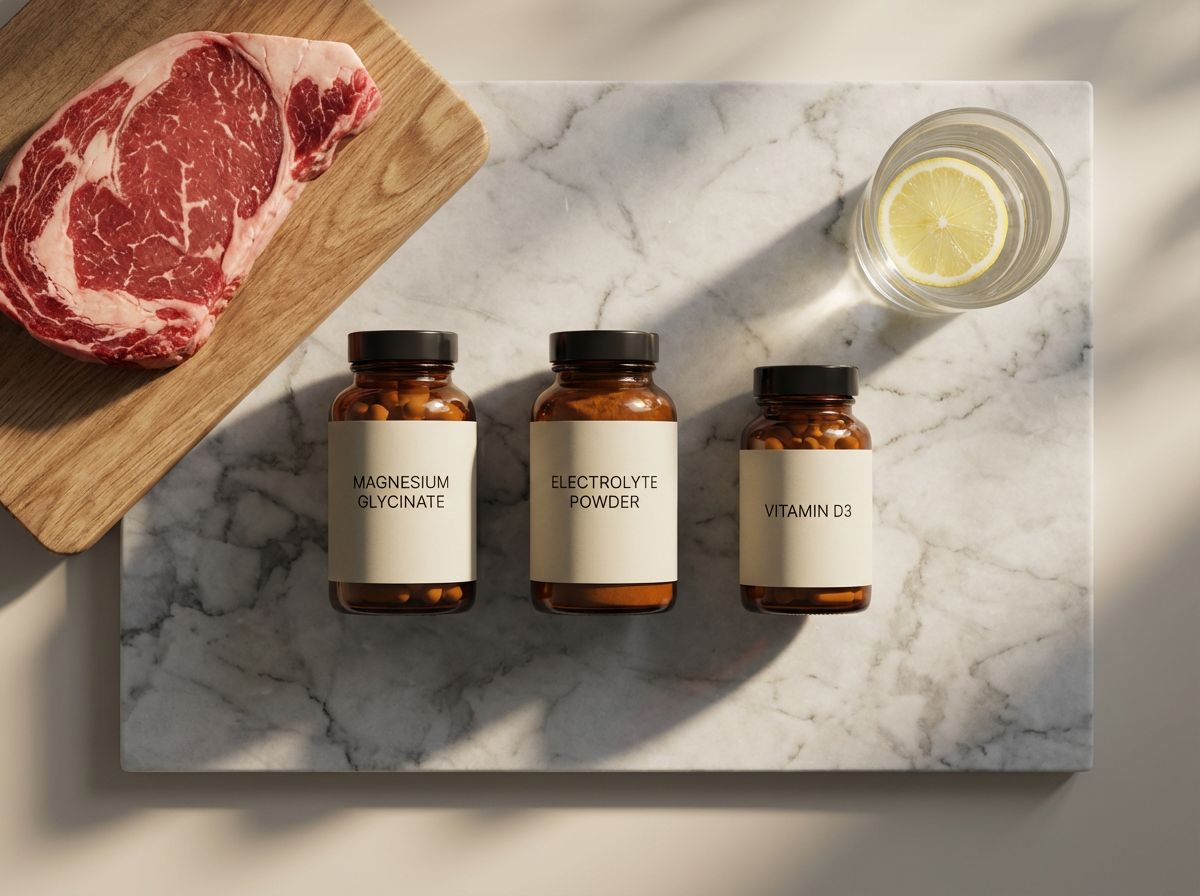
The 3 Supplements Worth Taking
On a properly executed carnivore diet, you're getting nearly everything from food. But three gaps exist:
1. Magnesium
2. Electrolytes (sodium/potassium)
3. Vitamin D (if deficient)
That's it. Everything else is either already abundant in meat or unnecessary for human health.
Magnesium: The Adaptation Supplement
Meat contains some magnesium, but not everyone lands where they want to be on it. Magnesium glycinate taken in the evening is the form most people tolerate best.
Why you need it:
- Muscle recovery and protein synthesis
- Sleep quality (magnesium regulates GABA)
- Energy production (ATP requires magnesium)
- Prevents cramping during adaptation
What to buy: Magnesium glycinate or magnesium citrate. Avoid magnesium oxide (poorly absorbed).
Dose: not one I can print for you. Magnesium interacts with a long list of prescriptions, including blood pressure medication and water pills, and it builds up when kidneys are not clearing it well. Take the bottle to your pharmacist and ask what is right for you.
Cost: $12-18 for a 2-3 month supply.
This is the single highest-ROI supplement on carnivore. Better sleep and recovery for $6 per month.
Electrolytes: Sodium and Potassium
Carnivore is diuretic. You excrete more water and sodium, especially in the first 4-8 weeks.
Low sodium = fatigue, weakness, brain fog, cramping. This isn't keto flu. It's electrolyte depletion.
One check before you add either one. If you take a daily pill for blood pressure or your heart, a water pill, or anything to do with your kidneys, talk to your doctor or pharmacist first. That covers potassium from a supplement, from a salt substitute like Lite Salt or No Salt, or from a daily electrolyte packet, and it covers how heavily you salt your food. Some of those medicines already hold potassium in your body, so extra on top is the problem rather than the help. Have the same conversation if a blood test has ever come back with a note about your potassium, your sodium, or your kidney function.
This page used to print daily sodium and potassium targets. I've taken them down rather than quietly swap in smaller ones. One target aimed at every reader is wrong for the readers it can hurt, and shrinking it does not make it theirs.
For everyone else, the practical version is short. Unsalted meat will leave you short on sodium, so salt your food and salt it to taste, and salt heavier on days you train hard or sweat a lot. Most people who feel wrecked in month one are under-salting and fix it at the table. Potassium comes along with the meat, which is why cramping that carries on after you have sorted your salt is worth a blood test rather than a potassium supplement.
Cost breakdown:
- Table salt: $2 for 6 months
- Electrolyte powder (LMNT, Redmond Re-Lyte): $35-45 for 30 servings
The cheapest option is plain salt. The convenient option is electrolyte powder.
Vitamin D: Test Before Supplementing
Vitamin D comes from sun exposure, not food. Carnivore doesn't change this.
Beef liver contains some vitamin D (~50 IU per oz), but nowhere near the 1000-2000 IU daily target for deficient individuals.
When to supplement:
- You live in a northern latitude (limited winter sun)
- You work indoors and don't get daily sun exposure
- Blood test shows deficiency (below 30 ng/mL)
When NOT to supplement:
- You get 15-30 minutes of direct sun exposure daily
- You live in a sunny climate year-round
- Blood test shows adequate levels (40-60 ng/mL)
Dose if supplementing: 2000-4000 IU daily (D3, not D2).
Cost: $10-15 for a 6-month supply.
Don't guess. Test your levels before supplementing. Vitamin D toxicity is rare but possible with chronic over-supplementation.
What About These Common Supplements?
Organ supplements (liver, heart, kidney capsules):
If you're eating fresh organs weekly, you don't need these. If you're not eating organs and refuse to start, fine—take desiccated organ capsules. But fresh liver is cheaper and more bioavailable.
Collagen peptides:
You're already getting collagen from connective tissue in meat. Eating skin, cartilage, and bone broth provides the same amino acids (glycine, proline). Supplementing collagen is redundant unless you're exclusively eating lean muscle meat.
Omega-3 fish oil:
Meat provides omega-3s (especially grass-fed beef and fatty fish). The omega-6:omega-3 ratio matters more than absolute omega-3 intake. On carnivore, you've eliminated seed oils, which immediately fixes your ratio. Fish oil supplementation is unnecessary unless you're eating zero fatty fish.
Vitamin C:
Meat contains enough vitamin C to prevent scurvy. Fresh meat has 10-30mg per lb. Your requirement drops on carnivore because vitamin C and glucose compete for the same cellular receptors. Low glucose = lower vitamin C needs. Sailors got scurvy because they ate hardtack and salted pork (no fresh meat). You're fine.
Probiotics:
Your gut microbiome adapts to carnivore within 3-6 months. Supplementing probiotics doesn't meaningfully alter this process. Save your money.
For more context on managing inflammation and recovery, understanding autoimmune remission can provide insight into how carnivore affects your immune system.
The Cost-Benefit Analysis
Let's compare the supplement bill for a typical "health-conscious" omnivore diet vs carnivore.
Standard omnivore supplement stack:
- Multivitamin: $20/month
- Protein powder: $40/month
- Fish oil: $25/month
- Vitamin D: $5/month
- Probiotics: $30/month
- Greens powder: $50/month
Total: $170/month
Carnivore supplement stack:
- Magnesium: $6/month
- Electrolytes: $15/month (or $1/month for plain salt)
- Vitamin D (if deficient): $2/month
Total: $23/month (or $9/month with plain salt)
That's $147-161 saved monthly. Over a year, that's $1764-1932.
The supplement industry doesn't want you to realize how much you're already getting from meat.
When to Test Blood Levels
Guessing at supplementation is inefficient. Test these markers 3-6 months into carnivore:
- Vitamin D (25-hydroxyvitamin D)
- Magnesium (RBC magnesium, not serum)
- Iron panel (ferritin, serum iron, TIBC)
- B12 (if you're concerned, though meat is loaded with it)
If levels are optimal, you're doing it right. If something's low, adjust.
Blood work removes the guesswork. You're not supplementing based on marketing claims—you're supplementing based on your actual physiology.
The Bottom Line
On carnivore, you need:
- Magnesium: glycinate in the evening, with the dose cleared by your pharmacist
- Sodium: salt your food to taste, more when you train hard or sweat, unless your doctor has capped it
- Vitamin D: Only if blood test shows deficiency or you get no sun
Everything else is optional or redundant.
The supplement industry built a $50 billion empire convincing you that food isn't enough. On carnivore, food is enough.
Save your money. Buy better meat instead.
Not a doctor. I've coached people and competed myself, so I know what works in practice. But I'm not your doctor. Doses are where this gets real: magnesium interacts with a long list of medications, high-dose vitamin D without testing is a bad idea, and 3 to 5 grams of sodium is still the wrong instruction for anyone with kidney disease, heart failure, or blood pressure medication on board. Lowering the number does not make it your number. Ask your prescriber what your sodium ceiling is before you salt anything, and get cleared before you start supplementing. Your mileage may vary.