
This post may contain affiliate links. For educational purposes only, not medical advice. Details
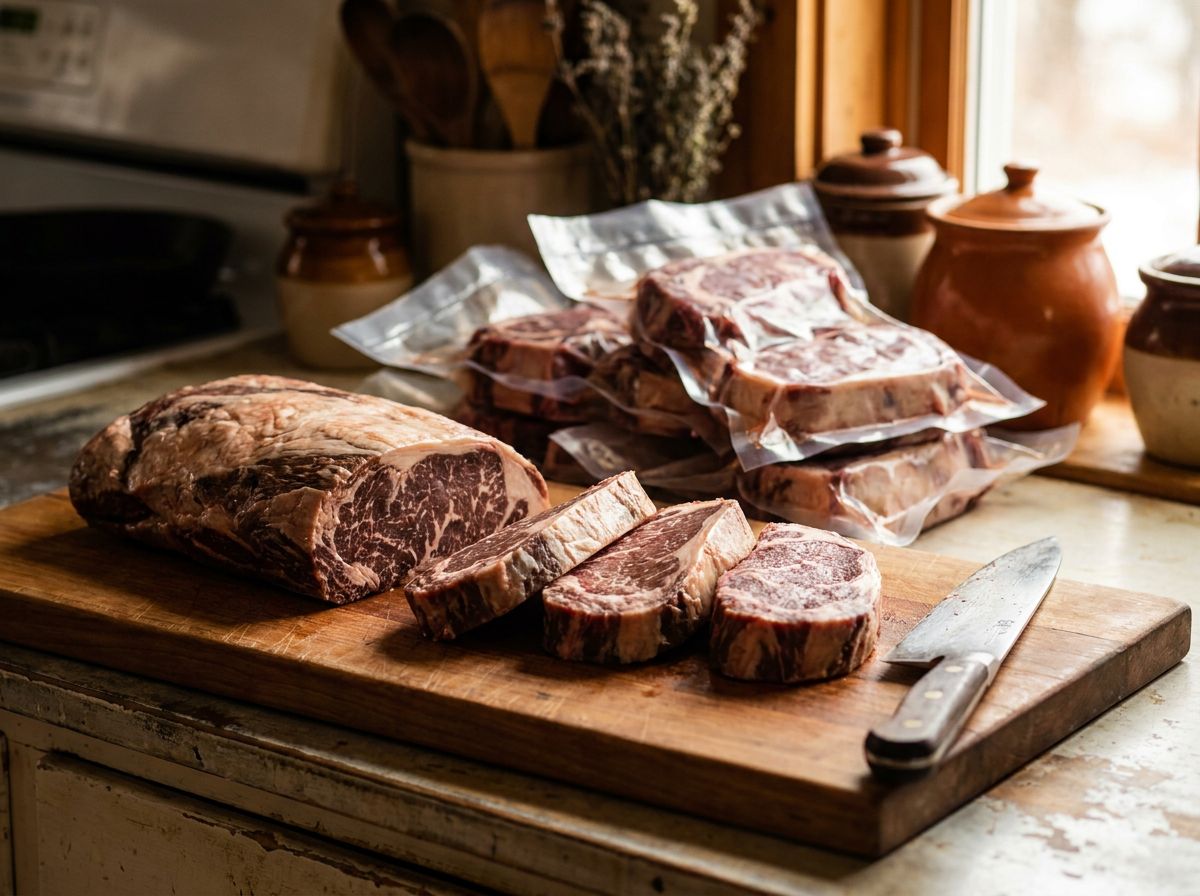
Stop Buying Individual Steaks. Here's Why.
A 125-upvote post hit r/carnivorediet this week. Someone bought a whole NY strip loin from Costco and started cutting their own steaks at home. The comments were gold: vacuum sealer recommendations, tallow rendering tips, and people sharing their monthly grocery budgets dropping below $250.
This is the protocol. If you're eating carnivore long-term, buying whole sub-primals is the single biggest move you can make for your budget. I've been recommending this exact approach to athletes I coach for years. A strength coach I met over dinner at a metabolic health conference in San Diego told me his entire gym does the same thing—buys whole ribeye rolls for his competitive lifters and portions them out weekly. When guys who train at that level are doing their own butchering to save money, you know the protocol works. Let me show you the math.
The Cost Per Pound Breakdown
Here's what NY strip typically costs at Costco (prices vary by region, but ratios stay consistent):
- Individual NY strip steaks (USDA Choice): $15.99-17.99/lb
- Whole NY strip loin (USDA Choice): $10.99-12.99/lb
- Whole NY strip loin (USDA Prime): $13.99-15.99/lb
That's a 30-40% savings on the exact same meat. A typical whole strip loin weighs 12-16 lbs, so you're looking at $130-$200 for roughly 10-14 steaks depending on how thick you cut them.
One commenter on that Reddit thread nailed it: "I keep my entire monthly grocery budget at $250 and under because of this method." That's real. When you combine whole loins with bulk ground beef, you can eat premium carnivore for under $8/day. We broke down the ground beef side of this equation in our budget carnivore meals guide.
What You Need (Equipment List)
You don't need a butcher shop. Here's the minimum setup:
- A sharp chef's knife (8-10 inch): $30-50 for a decent one. You're cutting through muscle, not bone, so you don't need anything fancy.
- A large cutting board: Biggest one that fits your counter. Whole loins are long.
- A vacuum sealer: $40-80 for a basic model. Multiple commenters recommended getting the base model over the fancy ones. One person said, "Our luck the food sealers with the bells and whistles don't work or break early. The one I've had the longest is the base model."
- Vacuum sealer bags: Buy in bulk. About $15-20 for 50 bags.
Total startup cost: $85-150. You'll recoup this in your first or second loin purchase through savings.
How to Cut Your Own Steaks (Step by Step)
Step 1: Trim the exterior. Remove the thick outer fat cap if there is one. Don't throw this away. Set it aside for tallow (more on that below).
Step 2: Remove the chain meat. There's a strip of loose, ragged meat running along one side. Pull it off. It's great for stir fry, ground into burgers, or just pan-fried as snack strips.
Step 3: Cut to your preferred thickness. This is where it gets personal. One commenter from the thread said they cut at 3/4" and wished they'd gone thicker. Here's the protocol:
- 3/4 inch: Quick sear, cooks fast, good for weeknight dinners
- 1 to 1.25 inches: The sweet spot. Great sear-to-pink ratio, holds juices well
- 1.5 to 2 inches: Restaurant-style thick cut. Needs reverse sear or sous vide for best results
Step 4: Vacuum seal in portions. Seal individually or in pairs. Label with the date. Lay flat in the freezer for the first 24 hours so they freeze in stackable shapes.
Freezer Strategy: Making It Last
A 14 lb loin cut into 1-inch steaks gives you roughly 12-14 steaks. If you're eating one per day, that's two weeks of dinners from a single purchase.
Vacuum-sealed steaks last 6-12 months in a standard freezer and up to 2-3 years in a deep freezer. We covered the full deep freezer strategy in an earlier post on maximizing your meat storage.
Defrosting protocol: Move one steak from freezer to fridge the night before. 24 hours in the fridge gives you a perfectly thawed steak. If you forgot, a sealed steak in cold water defrosts in about an hour.
Rendering Tallow From Trimmings
Don't waste the fat cap and trimmings. This is free cooking fat.
One commenter shared their exact process: "I use my mom's KitchenAid and got a meat grinder attachment to grind the fat trimmings and then throw them in a crock pot overnight to extract the tallow."
Here's the simplified protocol:
- Step 1: Cut trimmings into small pieces (1/2 inch cubes) or grind them
- Step 2: Place in a slow cooker on low for 8-12 hours
- Step 3: Strain through cheesecloth into mason jars
- Step 4: Let cool to room temperature, then refrigerate
A 14 lb loin typically yields 1-2 lbs of trimmings, which renders down to about 1-1.5 cups of pure beef tallow. That's a week or two of cooking fat, and it costs you nothing beyond what you already paid.
Tallow keeps 3-6 months in the fridge and up to a year in the freezer. Use it for searing steaks, frying eggs, or cooking ground beef.
Beyond NY Strip: Other Whole Cuts Worth Buying
NY strip isn't the only sub-primal worth buying whole. Here are other options carnivores in that thread mentioned:
- Whole ribeye roll: Fattier, more marbled. Usually $12-16/lb at Costco for Choice. Heavier (15-20 lbs).
- Whole sirloin top butt: Leaner, cheaper ($6-9/lb). Great for budget weeks.
- Whole pork shoulder: If you eat pork, these run $2-3/lb. Massive volume for the price.
- Whole chuck roll: One commenter keeps their budget at $250/month buying chuck rolls and ribeye rolls in bulk.
If you don't have a Costco nearby or want grass-fed options delivered, ButcherBox ships quality beef monthly and the per-pound cost on their bulk boxes is competitive with warehouse club pricing. I've had a few coaching clients use it when their closest Costco is an hour-plus drive.
Monthly Budget: Real Numbers
Let's put this together. Here's a realistic monthly budget using the bulk buying strategy:
- 2 whole NY strip loins (28 lbs): approximately $310-360
- 10 lbs ground beef (80/20): approximately $50-60
- 5 dozen eggs: approximately $15-25
- Butter (4 lbs): approximately $12-16
- Salt, electrolytes: approximately $10 (Sarah broke down the exact dosing protocol recently—LMNT packets run about $1.20 each if you don't want to DIY it)
Monthly total: $397-471 for two people. That's roughly $6.50-7.80 per person per day eating steak dinners. Compare that to buying individual steaks at $16/lb and you're saving $150-200 per month.
The Bottom Line
Buying whole sub-primals is the single highest-impact budget move for carnivore eating. The savings are real, the quality is identical, and once you've done it twice, the whole process takes 20 minutes.
Get a sharp knife, a vacuum sealer, and head to Costco. Cut your own steaks. Render your own tallow. Your wallet and your freezer will thank you. The money you save here adds up fast—Chloe tracked the hidden costs of carnivore weight loss last week and found that wardrobe replacements eat into budgets more than people expect. This is how you offset that.
I'm not a doctor. Everything here is based on what works in practice and what research supports. If you have health issues or take medications, check with someone qualified.