
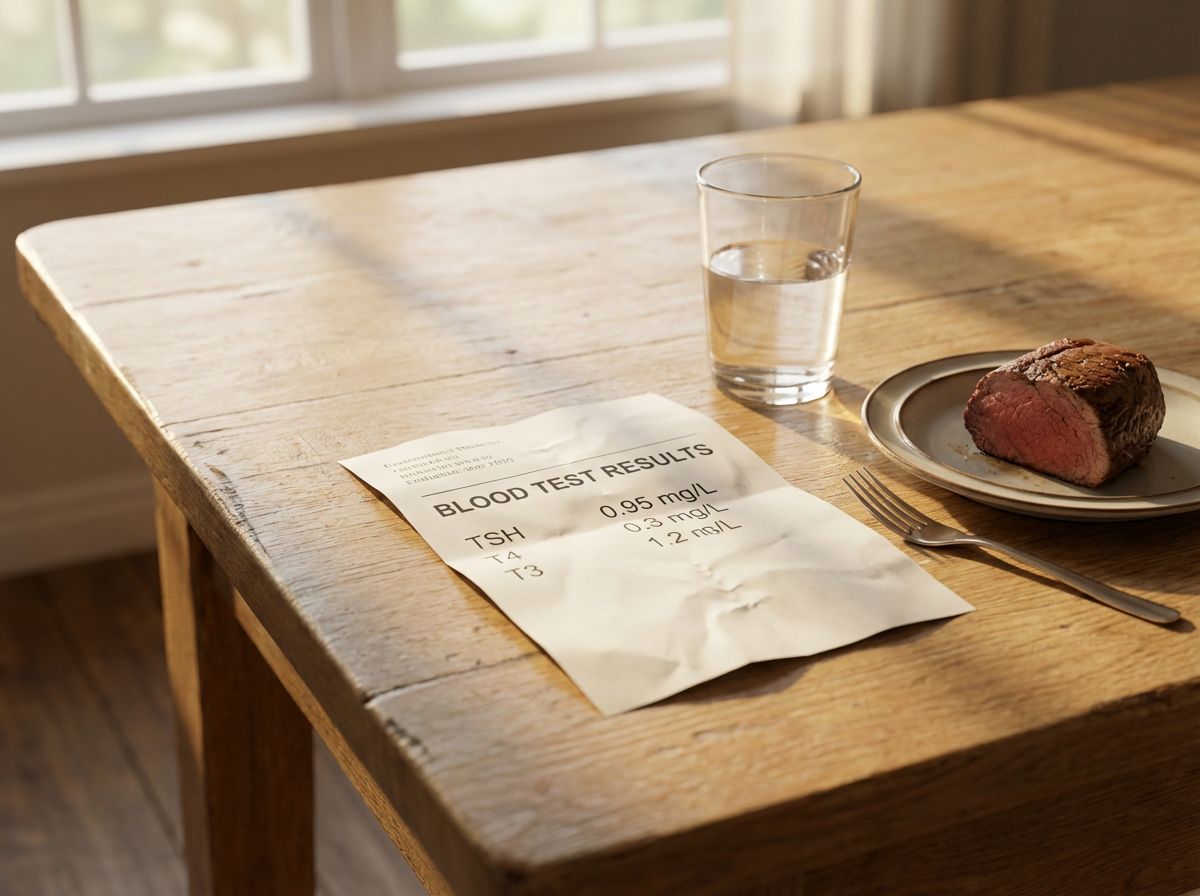
I've been coaching people through carnivore for years, and this conversation happens constantly:
"I got my thyroid labs back. My TSH went from 2.0 to 3.5. My doctor says my thyroid is failing and wants to put me on medication. Should I quit carnivore?"
Here's the truth: TSH alone doesn't tell you anything about thyroid health. And changes in TSH on carnivore are often metabolic adaptation, not thyroid dysfunction.
Let me show you what's actually happening.
Why TSH Alone Is Misleading
TSH (thyroid-stimulating hormone) is produced by your pituitary gland. It signals your thyroid to produce more thyroid hormones (T4 and T3). Higher TSH means your pituitary is working harder to stimulate thyroid hormone production.
The conventional interpretation:
- High TSH = hypothyroidism (underactive thyroid)
- Low TSH = hyperthyroidism (overactive thyroid)
But this is oversimplified. TSH is just one part of the feedback loop. What matters most is what's happening downstream: Free T3 and Free T4 (the actual active hormones), and reverse T3 (the inactive form).
You can have elevated TSH with:
- Normal Free T3 and Free T4 (subclinical hypothyroidism, often benign)
- Low Free T3 and normal Free T4 (conversion issue, not production issue)
- High reverse T3 (stress blocking T3 activation)
Each scenario requires different interpretation. TSH alone doesn't tell you which one you're in.
Metabolic Adaptation vs. Thyroid Dysfunction
One thing I've noticed: people confuse metabolic adaptation with thyroid problems.
When you go carnivore, especially if you're coming from a high-carb diet, your body becomes more metabolically efficient. It learns to do more with less. Part of this adaptation involves changes in thyroid hormone metabolism.
Metabolic adaptation looks like:
- Slight TSH increase (2.0 → 3.5)
- Slight Free T3 decrease (upper range → mid-range)
- Free T4 stable
- Reverse T3 stable or decreasing
- No symptoms (energy good, temperature normal, no hair loss, no weight gain)
This is your body becoming more efficient. Lower T3 doesn't mean "thyroid failure." It means your cells are using thyroid hormone more effectively, so you need less circulating hormone to maintain normal function.
Actual thyroid dysfunction looks like:
- TSH above 4.5-5.0 (and climbing)
- Free T3 in lower third of range (or below range)
- Free T4 in lower third of range
- Reverse T3 elevated (blocking T3 receptors)
- Symptoms present (fatigue, cold intolerance, hair loss, weight gain, brain fog, constipation)
The key distinction: symptoms. If your TSH is 3.5 but you feel great, that's adaptation. If your TSH is 3.5 and you're exhausted, freezing, and losing hair, that's dysfunction.
Free T3 and Free T4: The Hormones That Matter
TSH tells you what your pituitary is doing. Free T3 and Free T4 tell you what your thyroid is actually producing and what your cells are using.
Free T4 (thyroxine): This is the storage form of thyroid hormone. It's produced by the thyroid and converted to T3 in tissues (liver, kidneys, muscles).
Free T3 (triiodothyronine): This is the active form. It binds to receptors in cells and drives metabolic rate, energy production, and temperature regulation.
On carnivore, Free T4 usually stays stable. Free T3 may decrease slightly, especially in the first 8-12 weeks. This freaks people out, but it's often normal.
Why? Because carnivore reduces systemic inflammation and improves insulin sensitivity. When inflammation drops, your cells become more sensitive to thyroid hormone. You need less T3 circulating to achieve the same metabolic effect.
If Free T3 is in the mid-range and you feel good, that's optimal. You don't need upper-range T3 if your cells are using it efficiently.
Reverse T3: The Brake Pedal
Reverse T3 (rT3) is an inactive form of T3. Your body produces it when it wants to slow metabolism — during stress, illness, calorie restriction, or chronic inflammation.
High reverse T3 blocks T3 receptors, preventing active T3 from working. This creates "functional hypothyroidism" even if your T3 levels look normal on labs.
What causes high reverse T3:
- Chronic stress (cortisol blocks T4 → T3 conversion)
- Calorie restriction or fasting (metabolic slowdown)
- Chronic inflammation (inflammatory cytokines inhibit conversion)
- Insulin resistance (impairs liver conversion of T4 → T3)
On carnivore, reverse T3 usually decreases over time because inflammation drops and insulin sensitivity improves. If your reverse T3 is climbing, that's a red flag — investigate stress, overtraining, or inadequate calorie intake.
Optimal reverse T3: Below 15 ng/dL (some labs use different units, check your reference range).
Iodine on Carnivore: Do You Need More?
Iodine is required for thyroid hormone production. Your thyroid uses iodine to make T4 and T3. Without adequate iodine, TSH rises as your pituitary tries to compensate.
Carnivore provides some iodine from meat (especially organ meats), eggs, and seafood. But it's lower than a diet heavy in iodized salt or seaweed.
From my experience coaching, most people on carnivore don't need iodine supplementation unless:
- You avoid seafood completely
- You use non-iodized salt (sea salt, Himalayan salt)
- You have a history of iodine deficiency or goiter
- Your TSH is climbing despite good Free T3/T4
If you suspect iodine deficiency, add:
- Seafood 2-3x per week (salmon, sardines, shrimp, cod)
- Eggs (yolks contain iodine)
- Iodized salt instead of sea salt
- Kelp or dulse flakes (sprinkle on food)
Don't megadose iodine without testing. Too much iodine can trigger autoimmune thyroid issues (Hashimoto's) in susceptible individuals.
When to Test Beyond TSH
If your doctor only checks TSH, you're missing the full picture. Here's what to ask for:
Complete thyroid panel:
- TSH (pituitary signaling)
- Free T3 (active hormone)
- Free T4 (storage hormone)
- Reverse T3 (metabolic brake)
- Thyroid antibodies (TPO, Tg) if autoimmune thyroid is suspected
This gives you the full feedback loop: what your pituitary is doing (TSH), what your thyroid is producing (Free T4), what your tissues are converting (Free T3), and what's blocking conversion (reverse T3).
Without this panel, you're guessing.
When Elevated TSH Is Normal Adaptation
Here's what I've seen work: if your TSH is between 2.5-4.5 and you meet all these criteria, it's likely normal adaptation, not dysfunction:
- Free T3 is mid-range or higher
- Free T4 is mid-range
- Reverse T3 is normal or low
- Energy is good
- Body temperature is normal (97.8-98.6°F upon waking)
- No hair loss
- No unexplained weight gain
- No severe constipation
- No cold intolerance
If all of the above are true, your thyroid is functioning fine. The TSH increase is just your pituitary recalibrating to your new metabolic state. You don't need medication.
When Elevated TSH Is Actually a Problem
If your TSH is above 4.5 or climbing, and you have symptoms, investigate further.
Red flag symptoms:
- Persistent fatigue despite adequate sleep
- Cold intolerance (always freezing when others are comfortable)
- Hair loss (especially outer third of eyebrows)
- Weight gain that doesn't respond to calorie reduction
- Severe constipation
- Brain fog, memory issues
- Depression or severe mood changes
If you have 3+ symptoms plus elevated TSH, get a full thyroid panel. Check for:
- Low Free T3 (below mid-range)
- Low Free T4 (below mid-range)
- High reverse T3 (above 15 ng/dL)
- Thyroid antibodies (TPO, Tg) — positive antibodies indicate Hashimoto's autoimmune thyroiditis
If Free T3 is low and reverse T3 is high, the issue is conversion, not production. This often resolves by addressing stress, improving sleep, and ensuring adequate calories and carbs.
If Free T4 is low, the issue is thyroid production. Consider iodine intake, selenium (for T4 → T3 conversion), and ruling out autoimmune issues.
How to Support Thyroid Function on Carnivore
If you're experiencing thyroid symptoms on carnivore, here's what I recommend:
1. Ensure adequate calories
Chronic calorie restriction raises reverse T3 and lowers Free T3. Eat to satiety. If you're trying to lose weight, don't cut calories aggressively — let carnivore regulate appetite naturally.
2. Include seafood regularly
Seafood provides iodine and selenium, both critical for thyroid function. Aim for 2-3 servings per week (salmon, sardines, shrimp, oysters).
3. Consider adding organ meats
Liver, heart, and kidney provide selenium, zinc, and B vitamins — all important for thyroid hormone conversion. Start with 2-4 oz of liver per week.
4. Manage stress
Chronic stress raises cortisol, which blocks T4 → T3 conversion and raises reverse T3. Prioritize sleep, avoid overtraining, and address chronic stressors.
5. Test selenium levels
Selenium is required for the enzyme that converts T4 to T3 (deiodinase). If you're low in selenium, conversion suffers. Brazil nuts (1-2 per day) or seafood can help.
6. Consider adding small amounts of carbs
Some people (especially women, especially active individuals) need small amounts of carbs to support optimal thyroid function. Honey, fruit, or white rice (25-50g carbs per day) can help maintain Free T3 without kicking you out of fat adaptation.
How to Talk to Your Doctor
Most doctors see elevated TSH and immediately prescribe thyroid medication. Here's how to navigate that conversation:
What to say:
- "I understand TSH is elevated. Can we check Free T3, Free T4, and reverse T3 to see the full picture?"
- "I don't have symptoms of hypothyroidism. Can we monitor trends before starting medication?"
- "What's causing the TSH increase? Is this primary thyroid failure or a conversion issue?"
- "Can we test thyroid antibodies to rule out autoimmune thyroiditis?"
What not to say:
- "TSH doesn't matter." (It does, but context matters more.)
- "My carnivore coach said ignore it." (Provide data, not anecdotes.)
- "I refuse medication no matter what." (If you have true hypothyroidism, medication may be necessary.)
If your doctor refuses to order a full thyroid panel or pushes medication based on TSH alone, consider finding a functional medicine practitioner familiar with thyroid function on low-carb diets.
The Bottom Line
Your TSH went up on carnivore. That doesn't automatically mean thyroid failure.
What matters most: Free T3, Free T4, reverse T3, and symptoms. If your Free T3 is mid-range, reverse T3 is low, and you feel good, your thyroid is fine. The TSH increase is metabolic adaptation.
If you have symptoms (fatigue, cold intolerance, hair loss, weight gain), get a full thyroid panel and investigate. Address stress, ensure adequate iodine and selenium, consider adding small amounts of carbs, and work with a practitioner who understands thyroid physiology.
Don't let a single TSH number scare you off carnivore when everything else is improving. Context matters. Test the right markers, interpret them correctly, and trust your body's signals.