
This post may contain affiliate links. For educational purposes only, not medical advice. Details
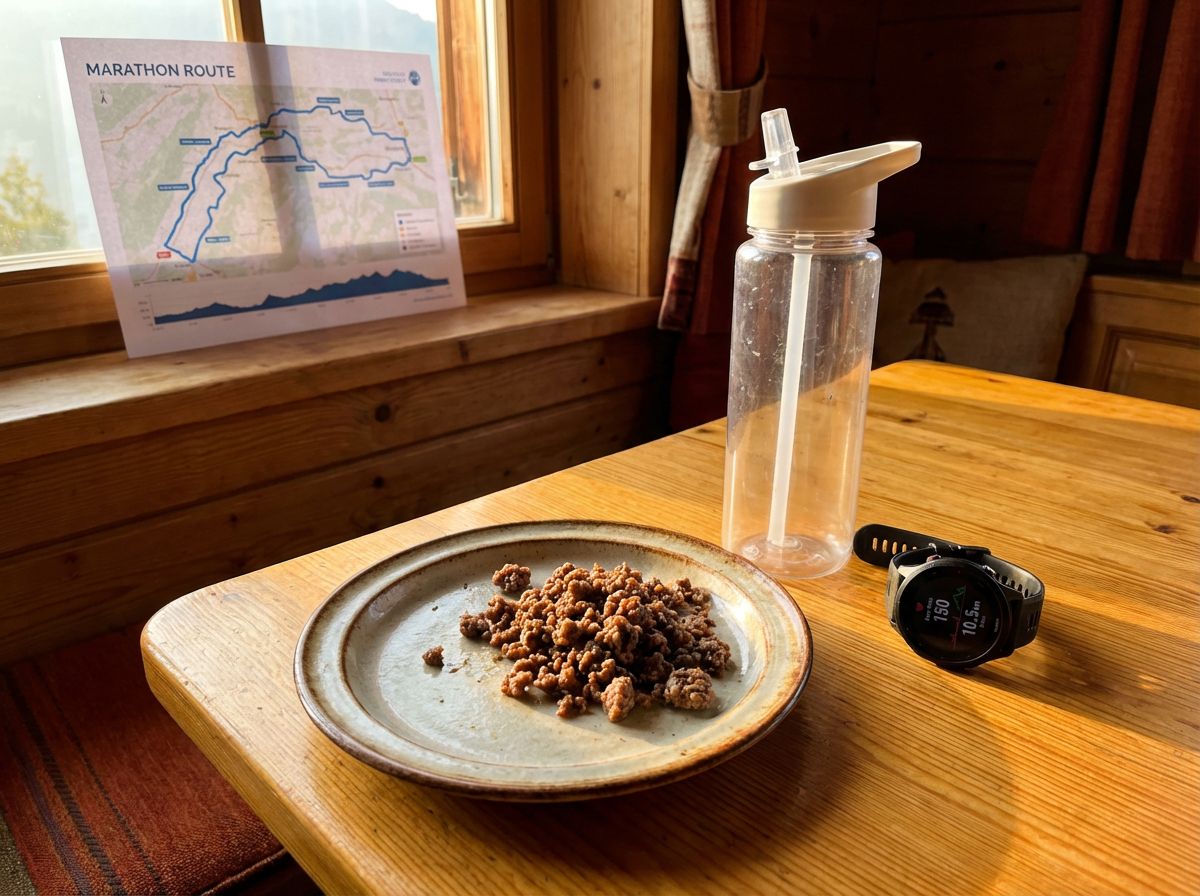
Every marathon training plan includes carb-loading pasta dinners, mid-run gels, and post-race bagels. Sports nutrition science runs on the assumption that endurance requires glucose.
Here's what actually happens when you run a marathon on carnivore.
Fat Adaptation for Endurance
Your body has two fuel tanks: glycogen (limited) and fat (nearly unlimited).
Glycogen stores max out around 2000 calories. That's 18-20 miles of running for most people. After that, you bonk. This is why marathon runners carb-load and consume gels every 45 minutes.
Fat stores on even a lean runner exceed 50,000 calories. The limitation isn't availability. It's access. Your body needs to upregulate fat oxidation enzymes.
On carnivore, this happens naturally. After 8-12 weeks, you're burning fat as your primary fuel. Your glycogen stores become secondary, used sparingly for high-intensity surges.
This is called glycogen sparing. You still have glycogen. You just don't deplete it in the first hour. Understanding this metabolic shift parallels what happens with strength gains without carbs. Your body adapts to use alternative fuel sources efficiently.
The Adaptation Timeline
Switching to carnivore mid-training block will temporarily wreck your pace. Here's the predictable progression:
Weeks 1-3: Performance drops 15-25%. Your easy pace slows by 30-60 seconds per mile. Long runs feel harder. This is normal. Your mitochondria are adapting to prioritize fat oxidation.
Weeks 4-6: Performance stabilizes. Pace returns to within 10-15 seconds of baseline. Energy feels more consistent mile-to-mile.
Weeks 7-10: Performance matches pre-carnivore levels. You notice less bonking on long runs. No need for mid-run fueling.
Week 12+: Full fat adaptation. Many runners report improved endurance and pace beyond pre-carnivore baseline. Energy remains stable for 2-3 hour runs without external fuel.
The key: don't switch to carnivore 6 weeks before a goal race. Give yourself 12+ weeks to fully adapt.
Training Zones on Carnivore
Fat oxidation peaks in Zone 2 (conversational pace, 60-70% max heart rate). This is your endurance-building zone.
On carnivore, you can extend Zone 2 efforts indefinitely without external fuel. Your glycogen stores remain intact because you're primarily burning fat.
Zone 2 training protocol:
- Target: 60-70% max heart rate
- Pace: Conversational, can speak in full sentences
- Duration: 60-180 minutes
- Frequency: 3-5x per week
This is where carnivore shines. You don't bonk. You don't need gels. You just run.
Zone 4-5 (threshold and VO2 max):
High-intensity work still recruits glycogen. On carnivore, you have glycogen. You're just not burning it during easy efforts.
Interval workouts, tempo runs, and race pace efforts work identically on carnivore. You're using the same energy systems.
Sample weekly training split:
- Monday: Easy 6 miles (Zone 2)
- Tuesday: Intervals (6x800m at 5K pace, Zone 4-5)
- Wednesday: Easy 5 miles (Zone 2)
- Thursday: Tempo run (4 miles at half-marathon pace, Zone 3-4)
- Friday: Rest or easy 3 miles
- Saturday: Long run 12-20 miles (Zone 2)
- Sunday: Easy 4-6 miles or rest
Training structure doesn't change. Fuel source does.
Race Day Fueling Strategy
On carnivore, you don't need mid-race gels. But you still need electrolytes.
Pre-race (2-3 hours before):
Moderate protein, moderate fat. Example: 6 oz steak, 2 eggs, salt.
Avoid eating a massive meal within 90 minutes of the start. Digestion competes with performance.
During the race:
For marathons (2-4 hours), you don't need calories. You do need a fluid and electrolyte plan, and that plan should have your doctor's fingerprints on it rather than mine.
Here's the physiology. Two runners standing side by side on the same start line, same weather, same pace, lose sodium in their sweat at very different rates. Not a little different. One can be losing it roughly three times faster than the other. That spread is the whole reason a published per-hour replacement figure is useless to you as an individual: it's an average of people who aren't you, and you can't tell from the outside which end of the range you sit at. What is worth knowing is that sodium depletion late in a race looks a lot like glycogen depletion, so runners misread it as bonking: fatigue, weakness, mental fog.
It also looks like the opposite problem. Drinking large volumes of plain water through a marathon can dilute your blood sodium, and that is a genuine emergency that has killed runners. Nausea, headache, weakness and confusion show up in both. You cannot tell which one you have from how you feel, and that is the whole reason this article doesn't hand you a dose.
What to do instead:
- Rehearse the exact plan on long runs, in similar weather, at goal pace. Whatever you carry on race day should be something your gut has already done 18 miles with. The expo hands out free samples for a reason, and race morning is the worst possible time to accept one.
- Read the race's aid station plan before you travel. Find out what they're pouring, at which miles, and whether it's mixed on site. If you're carrying your own, know exactly where you can top up water.
- Drink to thirst rather than on a rigid schedule. Thirst is a better instrument than a watch beeping every 15 minutes, and it protects you in both directions.
- Keep a short log through the training block: temperature, humidity, how long you were out, what you drank, how you felt at the end, and whether your kit dried out crusted with salt. That's data about you, in the conditions you actually run in.
- Set the sodium side of the plan with your doctor or a sports dietitian before race week. That goes double if you take blood pressure or diuretic medication, have kidney or heart disease, or you're pregnant.
- Stop and get help for confusion, nausea, a headache that won't clear, or a pace falling apart for no reason you can explain.
Skip the gels. That part still holds. The electrolyte dose is a medical question.
Post-race:
High protein, high fat. This is muscle recovery fuel.
Example: 12 oz ribeye, 4 eggs, butter, salt. Go big.
Ketones and Performance
On carnivore, your liver produces ketones as a byproduct of fat metabolism. Ketones provide an alternative fuel for your brain and muscles during prolonged efforts.
This doesn't mean carnivore is ketogenic. Your protein intake keeps you in low-level ketosis (0.5-1.5 mmol), not deep ketosis (3+ mmol).
For endurance, low-level ketosis is ideal. Your brain has fuel. Your muscles spare glycogen. You avoid the deep ketosis side effects (reduced power output, adaptation overhead).
You're not keto. You're fat-adapted carnivore. It's a different metabolic state.
Managing Electrolytes on Long Runs
Carnivore is diuretic. You lose more sodium and water than on a standard diet, especially in the first 8-12 weeks.
Combine this with sweat loss during a 2-hour run, and sodium depletion becomes the limiting factor, not energy availability. For a comprehensive breakdown of why this happens, see our guide on electrolyte balance on carnivore.
Daily sodium: There's no single endurance number that fits every runner. Training load, heat, sweat rate, blood pressure, kidney function and medication all move it, which is why that one belongs to your doctor and not to me.
Before long runs: Eat a normal salted meal a couple of hours out and start already hydrated. Bone broth works well for people who don't want solid food close to a run.
On runs over 90 minutes: Carry fluid, drink to thirst, and use whatever electrolyte product you and your doctor have settled on. Test it in training, never for the first time on race day.
Reading an electrolyte label: Check sodium per serving and what the brand counts as a serving, because some mean one scoop and some mean two. Check the potassium, since that's the ingredient that interacts with heart and blood pressure medication. Check for sugar and maltodextrin, because plenty of "electrolyte" products are sports drinks in a smaller sachet. And treat "lite salt" or "salt substitute" as a potassium supplement, because that's exactly what it is.
Adjust the run, not just the bottle. Move long runs to the cool end of the day in summer. Run loops past your car or a fountain instead of a point-to-point you can't bail out of. Slow your easy pace when it's hot rather than defending a number on your watch. A lot of runners reach for a product when the real fix was the schedule.
One thing not to do: don't diagnose yourself by feel. Cramping and mid-run weakness get blamed on sodium constantly, but heat, pace, sleep, iron status, thyroid, medication and simply doing more than you're trained for all produce the same sensation. Reaching for salt because you feel rough is guessing, and for some readers it's guessing with their blood pressure.
Comparing Performance: Carb-Fueled vs Fat-Adapted
Carb-fueled endurance:
- Energy peaks and crashes as glycogen depletes
- Requires gels every 45-60 minutes
- Risk of GI distress from mid-run fueling
- Bonking risk after 18-20 miles
Fat-adapted carnivore endurance:
- Stable energy for 2-4 hours without external fuel
- No gels needed (electrolytes only)
- No GI distress from sugary gels
- Glycogen sparing extends endurance capacity
The tradeoff: fat adaptation takes 12 weeks. Carb-loading works immediately.
If you have a race in 4 weeks, don't switch to carnivore. If you're training for next season, carnivore offers a long-term performance advantage. Many runners transitioning to carnivore also experience improvements in autoimmune symptoms, which can further enhance training consistency.
Ultra-Endurance and Carnivore
For ultra-marathons (50K, 50-mile, 100-mile), fat adaptation becomes a massive advantage.
Carb-fueled ultra runners consume 200-300g of carbs during a 100-miler. That's 30-40 gels, with compounding GI distress.
Fat-adapted carnivore runners consume zero calories mid-race (only electrolytes). GI distress disappears. Energy remains stable.
The longer the event, the greater the carnivore advantage.
The Bottom Line
Running a marathon on carnivore requires:
- 12+ weeks for full fat adaptation
- Zone 2 base building (60-70% max HR, 3-5x per week)
- A fluid and electrolyte plan set with your doctor, then rehearsed on every long run
- Fluid carried on runs over 90 minutes, drinking to thirst rather than to a timer
- Pre-race meal: moderate protein/fat 2-3 hours out
- Race fueling: no gels needed, fluid and electrolytes per your own plan
Carbs are not required for endurance. Fat oxidation is trainable. Once adapted, you have access to nearly unlimited fuel.
Sports nutrition built an industry on the assumption that endurance requires glucose. The physiology says otherwise.
That said, the transition isn't all smooth. There's a specific gap most runners hit that nobody warns you about. I covered it in the carnivore endurance problem nobody talks about, along with whether fasted training actually works on carnivore.
Not a doctor. I've coached people and competed myself, so I know what works in practice. But I'm not your doctor. Long-run fueling is medical territory for some people: diabetics, anyone on blood pressure or diuretic medication, and anyone with a heart condition should set their sodium and fluid plan with a physician before racing on this. Confusion, nausea, and a headache late in a long run means stop, not push. Your mileage may vary.